
Quick Answer: Ahrefs is the stronger tool for backlink analysis, technical site auditing, and competitive keyword research, starting at $129/month. Moz Pro is the better choice for beginners who want trusted Domain Authority metrics, a gentle learning curve, and a lower starting price at $99/month. Both are full SEO suites. Which one fits your workflow depends on your experience level, primary use case, and budget.
The Ahrefs vs Moz comparison looks straightforward on paper: one tool is more expensive, one is more beginner-friendly, and both cover the same broad category of SEO software.
But the decision between them is more consequential than a price comparison suggests, because the workflows they support are genuinely different and switching later costs significant time and data continuity.
This guide is written for three specific readers. Beginners who know Moz invented Domain Authority and want to know whether it is still the right starting point in 2026.
Growing bloggers and freelancers currently on Moz who are asking whether Ahrefs justifies the extra monthly cost at their current stage. And professional SEOs evaluating which platform to standardise their team’s workflow on for the long term.
Both tools are covered in full before the head-to-head comparison across every feature that matters.
By the end, you will know exactly which tool fits your current situation, at what budget, and at what stage of your SEO work you should consider switching from one to the other.
Ahrefs vs Moz at a Glance
Ahrefs leads on backlink depth, crawl accuracy, keyword database size, and technical site auditing. Moz leads on Domain Authority as an industry-standard metric, beginner accessibility, and a slightly lower starting price. Database and index figures below are vendor-reported.
| Feature | Ahrefs | Moz Pro |
|---|---|---|
| Best For | Backlink analysis, organic SEO depth | Beginners, DA metrics, small teams |
| Starting Price | $129/month (Lite) | $99/month (Standard) |
| Keyword Database | About 28.7 billion (reported) | Smaller, standard coverage |
| Backlink Index | About 35 trillion live links (reported) | Functional standard coverage |
| Site Audit | 170 plus issue checks, full JS rendering | Core crawl, no JS rendering |
| Domain Authority | Ahrefs Domain Rating (DR) | Moz Domain Authority (DA) — the industry original |
| AI Visibility | Brand Radar add-on from $199/month | Not available mid-2026 |
| PPC Research | Not available | Not available |
| Free Option | Ahrefs Free (own sites) | Limited free tier, MozBar free |
| Ease of Use | Moderate learning curve | Gentle, beginner-friendly |
What Is Ahrefs?
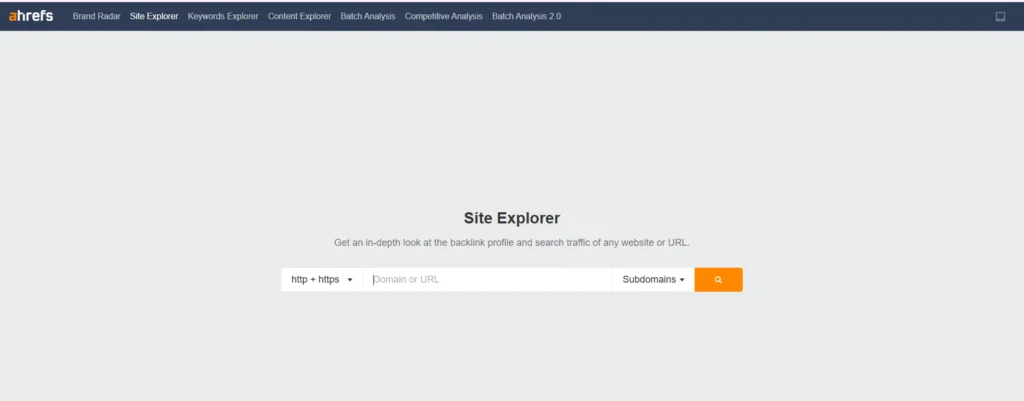
Ahrefs is a professional SEO platform launched in 2011, used by over 10,000 agencies and content operations worldwide as a primary tool for backlink analysis, keyword research, site auditing, rank tracking, and content research.
It launched as a backlink analysis specialist before expanding into a full SEO suite. It has never competed on price with budget tools and has never positioned itself as a beginner platform.
It suits professional bloggers, SEO agencies, affiliate marketers scaling competitive sites, and in-house content teams who need accurate competitive data to make content investment decisions.
Its signature advantage is the combination of its backlink index depth and the Traffic Potential metric, which estimates total traffic from ranking first rather than just reporting the search volume of one target keyword.
What Is Moz?
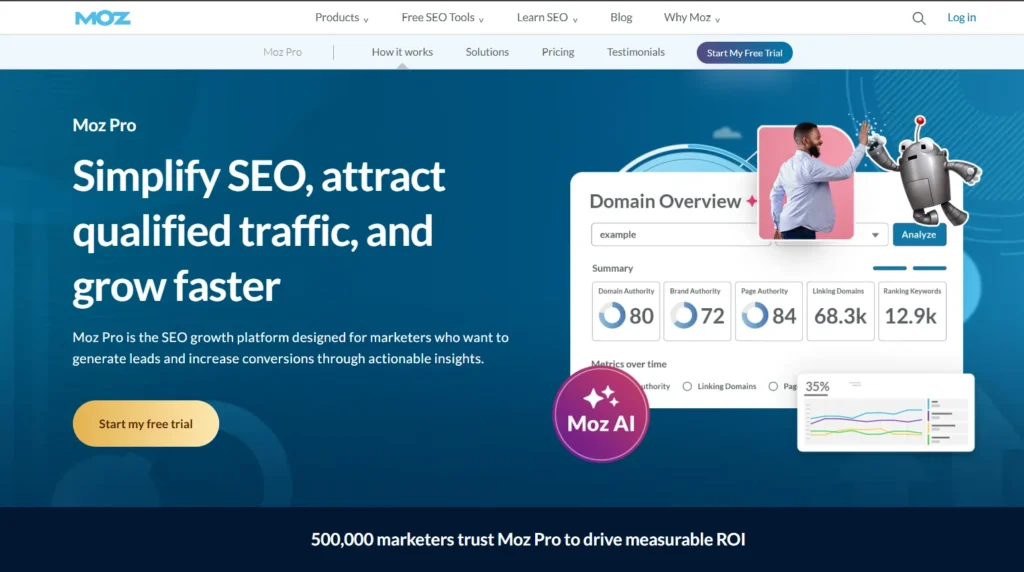
Moz is an SEO platform founded in 2004, making it the oldest tool in most SEO comparisons and the platform that invented Domain Authority, the most widely recognised link authority metric in the SEO industry. Its tools cover keyword research, backlink analysis, site crawling, rank tracking, and on-page optimization guidance.
Moz built its reputation first through its community blog and educational resources before its toolset became a primary product. That educational emphasis is still visible in how the platform presents data to users.
It suits beginners learning SEO, small in-house teams, digital marketing educators, and small business owners who want trusted authority metrics, a gentle onboarding experience, and access to one of the strongest SEO educational communities available. Its signature differentiator is Domain Authority, the single most cited metric in SEO reporting across the entire industry.
Ahrefs Key Features
- Keywords Explorer: About 28.7 billion keywords (reported) across Google, YouTube, Amazon, and Bing. Traffic Potential metric, intent classification, keyword clustering, Questions filter, Also Rank For report, and Related Terms filter.
- Site Explorer and Backlink Analysis: About 35 trillion live links (reported) with daily index updates. Link Gap analysis comparing your profile against five competitors, Top Pages report identifying which competitor pages earn the most links, toxic link identification, and referring domain trends.
- Site Audit: Over 170 issue checks covering crawlability, indexability, broken links, redirect chains, Core Web Vitals, and full JavaScript rendering for React, Vue, and Angular frameworks. Full access requires the Standard plan or above.
- Rank Tracker: Daily position monitoring by device and location down to city level, SERP feature tracking for featured snippets and People Also Ask, and competitor rank monitoring.
- Content Explorer: Top-performing content discovery by topic based on backlink count, organic traffic, and social shares. Available from the Standard plan at $249/month.
- Ahrefs Free: Free indefinitely for verified owners of your own domains. Includes site audit, backlink data, and keyword rankings for your own sites only, with no competitor research access.
Moz Key Features
- Domain Authority (DA): Moz invented DA, the most widely recognised link authority metric in the SEO industry. DA runs from 0 to 100 and predicts how likely a domain is to rank in search results based on its backlink profile. It is used universally in SEO reporting, competitor benchmarking, and link outreach qualification.
- Keyword Explorer: Keyword research with volume, Difficulty, Organic CTR, and Priority scoring. The Priority score combines volume, difficulty, and opportunity into one actionable number designed to help beginners make keyword decisions without needing to interpret multiple data points manually.
- Link Explorer: Backlink analysis with Spam Score per linking domain, Domain Authority, Page Authority, anchor text distribution, and basic new and lost link monitoring. Spam Score is Moz’s most distinctive backlink contribution.
- Site Crawl: Technical audit covering crawl errors, redirect issues, missing meta elements, duplicate content, and broken links on standard HTML sites. Interface presents issues with plain-language descriptions and fix guidance.
- Rank Tracking: Daily position monitoring across keyword sets with competitor comparison and visibility trending. Available on Standard plan and above.
- MozBar: Free Chrome extension showing DA and PA inline on Google search results pages indefinitely. No daily search limit. The most widely used free SEO browser extension in the industry.
Ahrefs Pricing (2026)
| Plan | Monthly Price | Who It Fits |
|---|---|---|
| Starter | $29/month | Very limited, occasional checks only |
| Lite | $129/month | Individual SEOs and small sites |
| Standard | $249/month | Growing content teams needing Content Explorer |
| Advanced | $449/month | Larger agencies |
| Enterprise | From $1,499/month | Enterprise teams |
Moz Pricing (2026)
| Plan | Monthly Price | Annual Price Per Month | Who It Fits |
|---|---|---|---|
| Starter | $49/month | $39/month | Very small sites, limited crawls |
| Standard | $99/month | $79/month | Small businesses and beginners |
| Medium | $179/month | $143/month | Growing businesses |
| Large | $299/month | $239/month | Agencies |
Ahrefs Pros and Cons
Pros:
- One of the largest backlink databases available at about 35 trillion live links (reported) with daily crawl updates
- Traffic Potential metric unique to Ahrefs gives a more realistic traffic estimate than raw search volume.
- Full JavaScript rendering in site audits for React, Vue, and Angular frameworks
- Multi-platform keyword research across Google, YouTube, Amazon, and Bing from one interface
- Ahrefs Free gives verified site owners genuinely useful backlink and audit data at zero cost.
- AI visibility tracking available via brand Radar add-on from $199/month
Cons:
- $129/month minimum for meaningful access is higher than Moz Pro Standard at $99/month
- Starter plan at $29/month is too restricted for most real SEO workflows
- Content Explorer requires the Standard plan at $249/month, not included in Lite
- No PPC advertising competitive research, unlike Semrush
- Steeper learning curve than Moz for users without a professional SEO background
Moz Pros and Cons
Pros:
- Invented Domain Authority, the most widely recognised and cited link authority metric in the industry
- Most beginner-friendly interface of any professional SEO platform in this comparison
- MozBar Chrome extension is free permanently, with no daily search limit and no account required for basic use.
- Spam Score metric is the most useful tool for identifying potentially harmful inbound links.
- Strong SEO educational community, blog, and beginner resources through Moz Learn
- Lower starting price at $99/month Standard compared to Ahrefs Lite at $129/month
Cons:
- No AI search visibility tracking available as of mid-2026, a meaningful gap versus Ahrefs, Semrush, and even Ubersuggest
- Smaller backlink database and less frequent crawl updates than Ahrefs
- Site Crawl does not support JavaScript rendering, missing issues on React, Vue, and Angular sites
- No PPC research capability at any plan level
- Interface feels more dated compared to Ahrefs for users comfortable with data-dense dashboards
- Not suitable for enterprise-scale workflows requiring daily data freshness and deep competitive intelligence
Ahrefs vs Moz: Keyword Research Comparison
Ahrefs for Keyword Research
Ahrefs Keywords Explorer draws from about 28.7 billion keywords (reported) across Google, YouTube, Amazon, and Bing.
The Traffic Potential metric is unique to Ahrefs and estimates total traffic from ranking first for a keyword by accounting for all related queries that the same page would also capture.
This gives a more accurate picture of the actual organic traffic opportunity than raw search volume alone, which many platforms report as the only volume metric.
Intent classification covers informational, commercial, transactional, and navigational keyword types. Keyword clustering groups related terms by topic, reducing manual planning time on large content calendars.
The Questions filter, Also Rank For report, and Related Terms filter give a complete semantic map of any topic from a single seed keyword.
Moz for Keyword Research
Moz Keyword Explorer covers standard keyword research with volume, keyword difficulty, Organic CTR estimates, and the Priority score.
The Priority score is the most distinctive Moz keyword feature: it combines search volume, difficulty, and organic click-through rate opportunity into a single number that tells beginners which keyword to target without requiring them to weigh three separate metrics manually.
The database is smaller than Ahrefs, which means fewer long-tail suggestions on niche topics and less granular competitive data on hard keywords.
For standard keyword research in established markets with moderate competition, it is functional. For deep competitive analysis or niche-specific long-tail discovery at scale, the gap versus Ahrefs becomes noticeable.
Verdict: Keyword Research
Ahrefs wins on database size, Traffic Potential accuracy, multi-platform coverage, and competitive filtering depth. Moz wins on accessibility for beginners who benefit from the Priority score as a single decision-making metric. For a deeper look at how Ahrefs keyword data compares against a budget alternative, see our Ahrefs vs KWFinder comparison.
Moz vs Ahrefs Backlinks: Which Has the Better Backlink Tool?
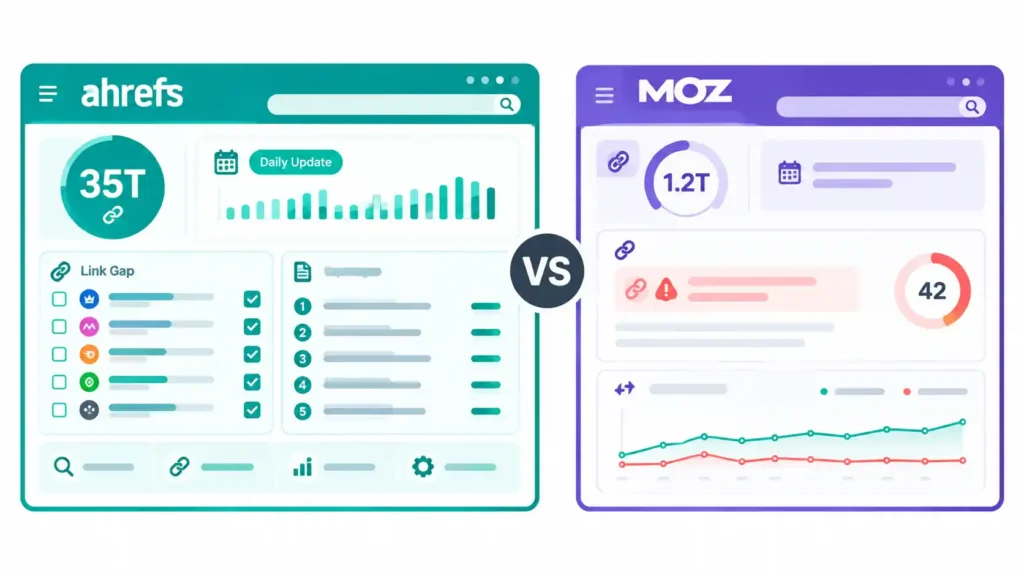
Ahrefs Backlink Analysis
Ahrefs backlink database covers about 35 trillion live links (reported) with daily index updates and among the fastest crawl frequencies in the industry.
New and lost links are detected quickly, which matters for active link building campaigns where timing outreach around competitor link activity produces better results.
Link Gap analysis compares your backlink profile against five competitors simultaneously and surfaces domains linking to them that do not link to you, giving a prioritised outreach target list.
The Top Pages report identifies which competitor pages earn the most external links, revealing which content formats and topics in your niche generate the most link acquisition.
For a deeper comparison of Ahrefs backlink data against another dedicated link analysis specialist, see our Ahrefs vs Majestic article.
Moz Backlink Analysis
Moz Link Explorer provides referring domain tracking, Domain Authority per linking domain, Spam Score per link, anchor text distribution, and basic new and lost link monitoring.
The Spam Score metric is genuinely useful for identifying potentially harmful inbound links during a link audit, and it is the most distinctive backlink feature Moz offers that Ahrefs does not replicate directly.
The database is smaller and updates less frequently than Ahrefs, which limits its usefulness for time-sensitive competitive link research. For routine monthly backlink health checks and Spam Score monitoring on small to mid-sized sites, Moz Link Explorer is functional.
Verdict: Moz vs Ahrefs Backlinks
Ahrefs wins on database size, crawl speed, link gap analysis depth, and competitive backlink research capability. Moz wins specifically on the Spam Score metric for identifying harmful inbound links during routine audits.
For active link building campaigns where detection accuracy and competitive intelligence matter daily, Ahrefs is the professional standard. Moz is adequate for monthly monitoring on smaller sites.
Ahrefs vs Moz Pro: Technical SEO and Site Audit Comparison
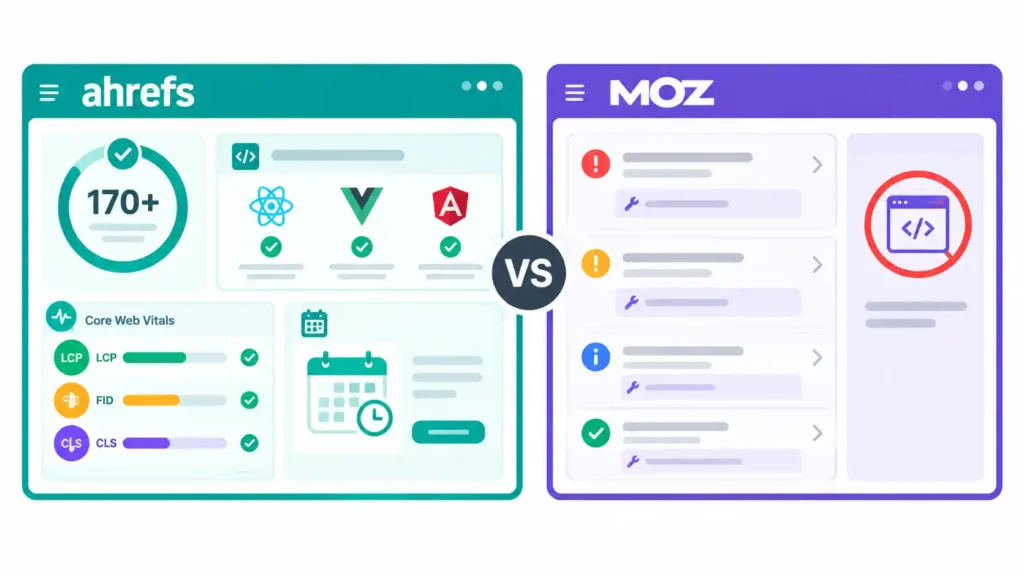
Ahrefs Site Audit
Ahrefs Site Audit runs over 170 issue checks covering crawlability, indexability, broken links, redirect chains, duplicate content, Core Web Vitals, and full JavaScript rendering for React, Vue, and Angular frameworks.
This JavaScript rendering support is the most operationally important advantage for auditing modern web properties where client-side rendering hides indexing issues from crawlers that do not support it.
Scheduled crawls with email alerts catch new issues between manual checks, and issue severity prioritisation tells you which problems to address first based on SEO impact.
Moz Site Audit
Moz Site Crawl covers crawl errors, redirect issues, missing meta elements, duplicate content, and broken links on standard HTML sites.
The interface is the most beginner-friendly of the two, presenting each issue with a plain-language description and a recommended fix that requires no technical SEO background to understand.
The crawl does not support JavaScript rendering, which means it will miss indexing issues on sites built with React, Vue, or Angular frameworks.
For conventional WordPress and static HTML sites with no complex frontend technology, the core crawl is functional and produces actionable results.
Verdict: Site Audit
Ahrefs wins on audit depth and JavaScript rendering support for technically complex modern sites.
Moz wins on interface accessibility for non-technical teams who need clear, plain-language issue explanations. For any site running React or another modern JavaScript framework, Moz’s crawl will miss issues that Ahrefs catches.
Domain Authority vs Domain Rating: Ahrefs vs Moz on Authority Metrics
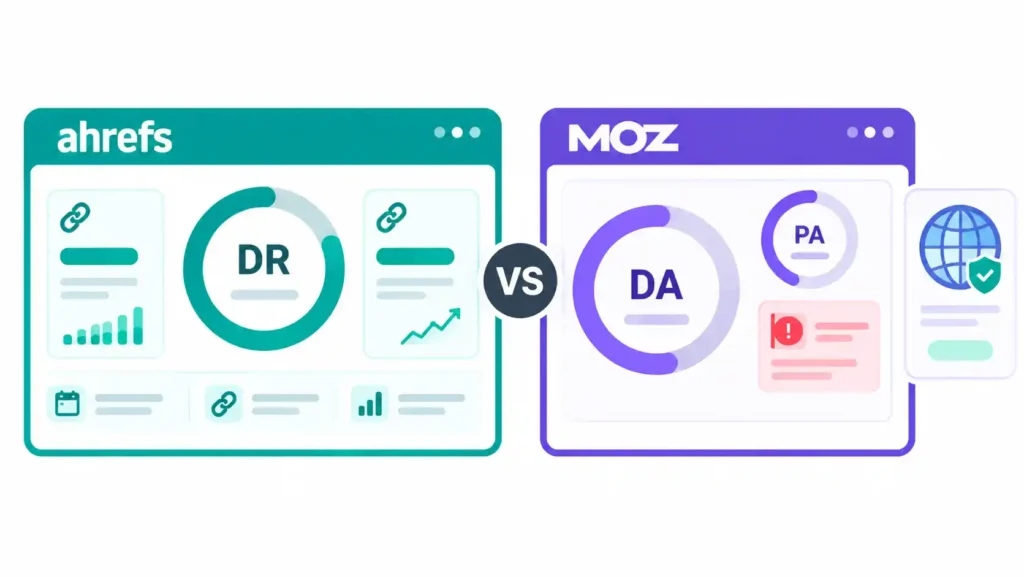
This is one of the most searched sub-topics in the Ahrefs vs. Moz comparison because both tools have a domain-level authority metric, and SEOs frequently ask which one to use in competitive research and link-building qualification.
- Moz Domain Authority (DA) is the original. Moz created DA in 2004 as a proprietary metric predicting a domain’s ability to rank in search results based on its backlink profile, scored from 0 to 100. Because Moz created it first and made it freely available through the MozBar extension, DA became the default language for discussing link authority across the entire SEO industry. When a client asks “what is the DA of that site?”, they almost always mean Moz DA specifically, not Ahrefs DR.
- Ahrefs Domain Rating (DR) is a proprietary Ahrefs metric measuring the strength of a domain’s backlink profile on a 0 to 100 logarithmic scale. It is calibrated to the Ahrefs backlink index, which means it reflects Ahrefs’ specific crawl data. DR tends to be more conservative on fresh domains and more precise on established sites than Moz DA because it is calibrated to a larger, more frequently updated backlink database.
Which should you use? For client reporting and link outreach qualification where the recipient needs to understand the metric immediately, Moz DA is the better communication tool because of its universal recognition. For internal competitive analysis where you want the most accurate link strength signal backed by the largest backlink database, Ahrefs DR is the more reliable metric.
Both are useful. Neither is a Google ranking factor. Neither is a substitute for real competitive keyword and backlink research.
Ahrefs vs Moz: Rank Tracking Comparison
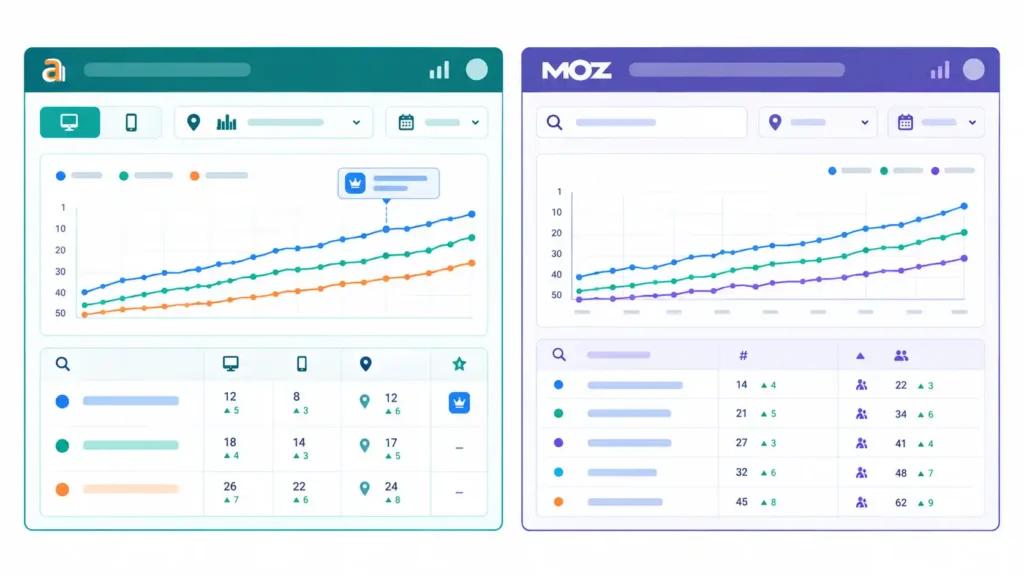
Ahrefs Rank Tracking
Ahrefs Rank Tracker provides daily position monitoring across keyword sets with device-specific (desktop and mobile) and location-specific tracking down to the city level.
SERP feature tracking shows when your tracked keywords trigger featured snippets, People Also Ask boxes, or local pack appearances alongside your standard position.
Competitor keyword monitoring runs alongside your own within the same tracking campaign, and a visibility percentage metric across your full keyword set gives an overall SERP presence indicator.
Moz Rank Tracking
Moz Rank Tracking covers daily position monitoring with competitor comparison and visibility score trending. The interface is cleaner and simpler than Ahrefs, making it faster to navigate for solo bloggers monitoring a single site’s keyword set without complex multi-location or SERP feature requirements.
Verdict: Rank Tracking
Both tools cover the core rank tracking requirement reliably for standard single-site monitoring. Ahrefs adds meaningful depth with SERP feature tracking, city-level location targeting, and more granular competitor monitoring. Moz is adequate and easier to navigate for users who do not need that additional granularity.
Ahrefs vs Moz: Customer Support and Resources
Ahrefs Support
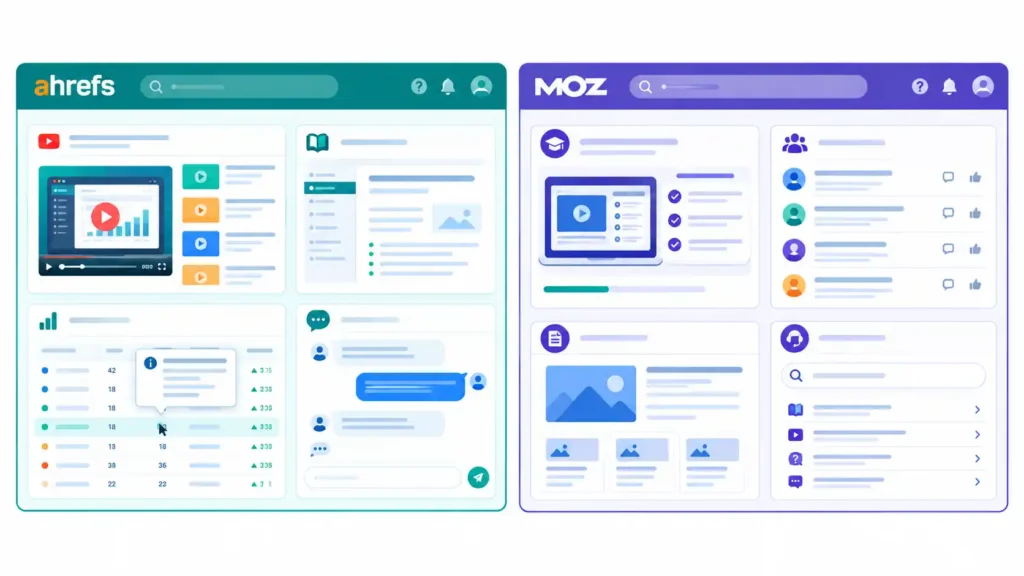
Ahrefs provides live chat support, email support, an extensive self-service knowledge base, and a large YouTube tutorial library with hundreds of walkthrough videos covering every tool in the platform.
Contextual tooltips throughout the interface explain metrics and features without requiring the user to leave the dashboard. For users who invest in learning the platform, Ahrefs’ educational resources are comprehensive and well-structured.
Moz Support
Moz has invested in community education more deeply than almost any other SEO tool. Moz Learn provides free online SEO courses covering fundamentals to advanced topics.
The Moz Blog is one of the most read SEO editorial resources in the industry. The community Q&A forum gives users access to peer support from experienced practitioners.
Email support and a help center cover platform-specific questions. For beginners who want to learn SEO alongside using a tool, Moz’s educational ecosystem is unmatched.
Verdict: Support and Resources
Moz wins on educational breadth and community resources for users who are learning SEO fundamentals. Ahrefs wins on tutorial depth for users already familiar with SEO who want to extract maximum value from specific tool features.
Which Tool Should You Choose?
| Your Situation | Best Pick |
|---|---|
| Learning SEO for the first time | Moz |
| Need trusted DA metrics for client reporting | Moz |
| Active link building as a core daily workflow | Ahrefs |
| Technical audit for a JavaScript-heavy site | Ahrefs |
| Budget under $100/month | Moz Standard |
| Need Traffic Potential for content decisions | Ahrefs |
| Multi-platform keyword research (YouTube, Amazon) | Ahrefs |
| Want a free tool for your own site first | Ahrefs Free |
| Small business with no SEO background | Moz |
| Growing affiliate site in a competitive niche | Ahrefs |
Choose Ahrefs If:
Backlink analysis and organic competitive research are core daily workflow functions where data accuracy is directly tied to your results. You need full JavaScript rendering in your site audit for a modern web property.
The Traffic Potential metric changes how you prioritise content investments. You want Ahrefs Free as a permanent starting point before committing to a paid plan.
Choose Moz If:
You are learning SEO and want the most beginner-friendly professional tool available alongside the strongest educational community in the industry.
Your clients or team require Domain Authority as a standard reporting metric. Your primary workflow is keyword research and basic backlink monitoring without the need for JavaScript rendering or enterprise-scale competitive intelligence. The MozBar free extension alone delivers daily value as you build your SEO confidence.
FAQs About Ahrefs vs Moz
Is Ahrefs better than Moz?
For professional SEO workflows involving active link building, competitive research, and technical site auditing, yes. Ahrefs has a larger backlink database, full JavaScript rendering in its site audit, the Traffic Potential metric, and multi-platform keyword research. For beginners who want trusted Domain Authority metrics, a gentle learning curve, and strong educational resources, Moz is the better starting point.
Is Moz still relevant in 2026?
Yes. Moz invented Domain Authority, which remains the most universally recognised link authority metric in SEO reporting across the entire industry. For beginners, small teams, and educators who need trusted metrics and clear data presentation, Moz Pro at $99/month delivers real value. Its main limitation in 2026 is the absence of AI visibility tracking and the lack of JavaScript rendering in its site crawl.
Which is cheaper: Ahrefs or Moz?
Moz is cheaper at the realistic entry point. Moz Standard costs $99/month (or $79/month on annual billing) compared to Ahrefs Lite at $129/month. The difference is $30/month or $360/year at monthly billing rates.
What is the difference between Ahrefs DR and Moz DA?
Both are 0 to 100 domain authority metrics based on backlink profiles. Moz invented Domain Authority in 2004 and it became the industry-standard term for link authority across SEO globally. Ahrefs Domain Rating is calibrated to the Ahrefs backlink index and is generally considered more precise for internal competitive analysis. For client-facing reporting where recognition matters, use Moz DA. For internal research accuracy, use Ahrefs DR.
Does Moz have a free plan?
Moz offers a limited free account with a small number of monthly searches across its tools. The MozBar Chrome extension is permanently free with no account required for basic DA and PA visibility on Google search results pages. Unlike Ahrefs Free, the Moz free tier does not include site audit or backlink data for your own domains.
Can Moz replace Ahrefs?
For basic keyword research, Spam Score backlink auditing, and DA metric reporting, yes. For active link building campaigns requiring deep backlink competitive analysis, technical site auditing on JavaScript-heavy sites, or Traffic Potential data for competitive content strategy, no. Moz does not have a direct equivalent to the Ahrefs Traffic Potential metric or JavaScript rendering in its site crawl.
Which tool is better for backlinks: Ahrefs or Moz?
Ahrefs is significantly better for professional backlink research. Its index of about 35 trillion live links (reported), with daily updates, is larger and more frequently refreshed than Moz’s. Link Gap analysis, Top Pages, and toxic link identification in Ahrefs go well beyond what Moz Link Explorer provides. Moz’s Spam Score is a useful addition for identifying harmful links but does not compensate for the overall database depth difference.
Which tool is better for keyword research: Ahrefs or Moz?
Ahrefs wins on keyword database size, Traffic Potential accuracy, multi-platform coverage, and competitive filtering depth. Moz’s Priority score is a genuine advantage for beginners who need one number to make keyword decisions rather than weighing multiple data points. For experienced SEOs making competitive content decisions, Ahrefs produces more actionable research data.
Final Thought
Ahrefs and Moz are both legitimate SEO platforms that have served the industry for over a decade. The right choice is not about which tool has a longer feature list.
It is about matching the tool to your current stage and workflow.
Start with Moz if you are building your SEO foundation and want the most accessible professional tool available. Move to Ahrefs when competitive data accuracy becomes operationally important to your results.
ALSO READ:


