
Quick Answer: Semrush is an enterprise-grade all-in-one SEO and marketing suite starting at $139/month, built for agencies and experienced marketers who need deep data, technical audits, and PPC intelligence. Mangools is a lightweight, beginner-friendly toolkit starting at $29/month, designed for solo bloggers and freelancers who want clean keyword research and rank tracking without complexity.
If you have spent any time researching SEO tools, Semrush Vs Mangools both are appeared on your shortlist.
But here is the thing most comparison articles skip over: these two tools are not actually competing for the same user. Mangools vs Semrush is not a close race where one narrowly beats the other.
It is a choice between completely different approaches to SEO, built for completely different stages of an SEO career. Mangools is significantly cheaper.
Semrush is significantly more powerful. The right answer has nothing to do with which one has the longer feature list and everything to do with what you actually need the tool to do for your site or your clients.
This comparison covers every feature category, both pricing structures, ease of use, free tool access, and customer support so you can make the decision in one read.
Semrush vs Mangools: Quick Summary
| Semrush | Mangools | |
|---|---|---|
| Best For | Agencies, enterprise, experienced SEOs | Beginners, bloggers, freelancers |
| Starting Price | $139.95/month | $29.90/month |
| Keyword Database | 25 billion plus keywords | ~700 million keywords |
| Site Audit | Full technical crawl (300 plus checks) | Not available |
| Backlink Analysis | Enterprise-grade | Basic (LinkMiner) |
| Content Marketing | Yes (full toolkit) | No |
| PPC Data | Yes | No |
| Ease of Use | Moderate to steep learning curve | Very easy |
| Free Option | Limited free account | 10-day free trial |
The summary above tells most of the story. If anything in the Semrush column sounds like overkill for where you are right now, Mangools is probably your tool.
If anything in the Mangools column sounds like a limitation you cannot work around, Semrush is worth the investment.
What is Mangools?
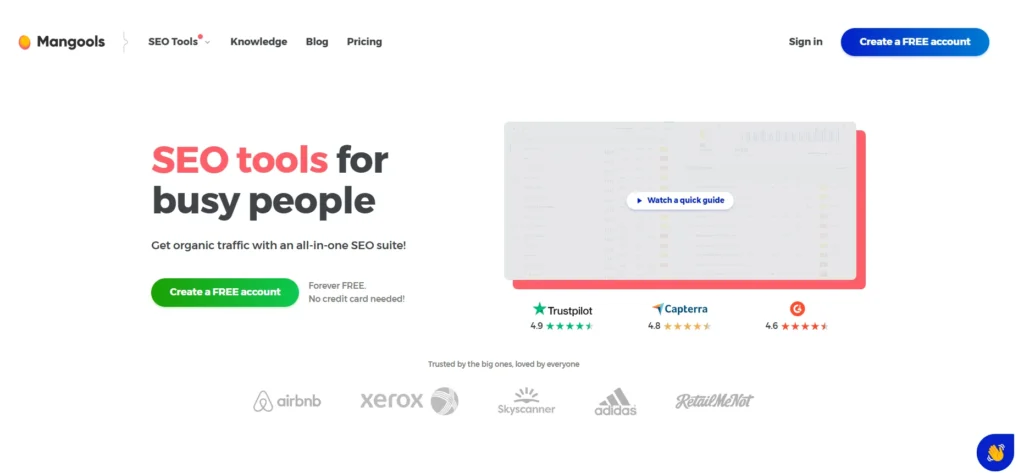
Mangools is a suite of five focused SEO tools launched in 2014, built around one specific philosophy: make SEO accessible without overwhelming the people who are just getting started.
The team behind Mangools made a deliberate choice to build fewer tools and build them well rather than trying to compete with enterprise platforms on feature breadth.
That decision has made Mangools genuinely popular among solo bloggers, freelance SEOs, affiliate marketers, and small business owners who primarily need keyword research and rank tracking done cleanly and quickly.
Also Read: 8 Best Mangools Alternatives in 2026 (Free, Paid & Cheaper Options)
What is Semrush?
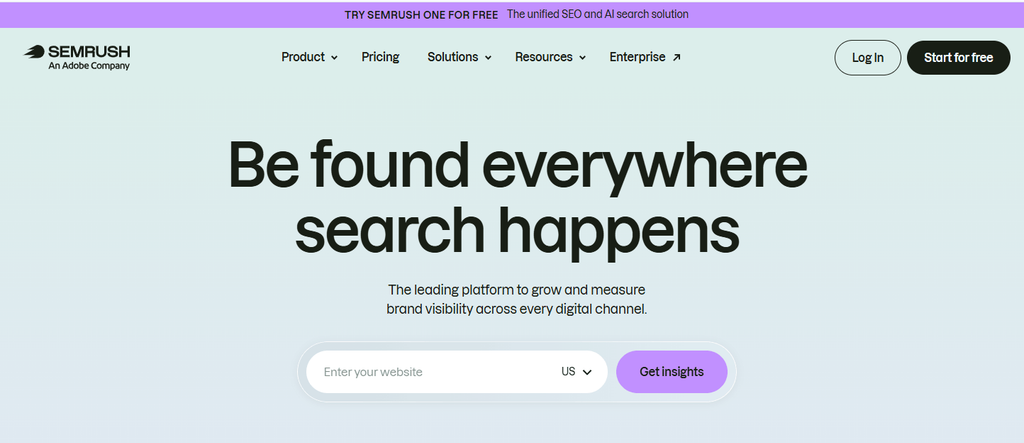
Semrush is a comprehensive SEO and digital marketing platform founded in 2008, now used by over 10 million marketing professionals worldwide.
It is one of the few tools that genuinely earns the label “all-in-one” because it covers not just SEO but also PPC research, content marketing, social media management, and deep competitive intelligence across all digital channels.
Where Mangools made the decision to do a few things very well, Semrush made the decision to build a platform that a marketing team or agency could use as its single source of truth across multiple channels and multiple client accounts.
Who it is built for: SEO agencies managing multiple client sites, in-house marketing teams at growing companies, experienced bloggers who are scaling content operations to a level where they need technical audit data and competitor intelligence, and marketers who need cross-channel data in one place rather than a patchwork of separate tools.
Mangools Key Features
- KWFinder: KWFinder is the flagship tool in the Mangools suite and the main reason most people sign up. You enter a seed keyword and get keyword suggestions ranked by search volume, trend data, and a color-coded difficulty score that makes it immediately obvious which keywords are within reach for a newer site. The SERP preview shows you the actual ranking pages for each keyword inline, so you can evaluate competition without switching tabs. For beginner bloggers doing their first rounds of content research, this workflow is significantly less intimidating than the equivalent in Semrush.
- SERPChecker: SERPChecker lets you analyze the search engine results page for any keyword and understand what it actually takes to rank there. You see each ranking page’s domain authority, page authority, backlink count, and other strength indicators side by side. This gives you a realistic sense of the competition before you commit to writing a piece targeting that keyword.
- SERPWatcher: SERPWatcher is Mangools’ rank tracking tool. It monitors your keyword positions daily and presents the data in clean trend charts that are easy to read at a glance. For a solo site owner tracking a manageable set of target keywords, SERPWatcher does everything needed without requiring you to learn a complex reporting interface.
- LinkMiner: LinkMiner handles backlink checking within the Mangools suite. You can look up the backlink profile of any domain or page, see referring domains, check link strength metrics, and identify potential link-building targets. It is functional for quick link research but is not built to compete with enterprise-grade backlink databases.
- SiteProfile: SiteProfiler gives you a rapid domain overview for any website. You see domain authority, trust flow metrics, top referring domains, and top organic keywords at a glance. It is useful for competitive research at a surface level and for quickly evaluating whether a domain is worth pursuing for a link-building campaign.
- Mangools Chrome and Firefox Extensio: The Mangools browser extension overlays SEO metrics directly into your Google search results pages. Without logging into any tool, you can see domain authority, backlink counts, and basic keyword metrics inline as you browse. For daily workflow speed, this is genuinely useful.
Semrush Key Features
- Keyword Magic Tool: The Keyword Magic Tool is Semrush’s primary keyword research interface and one of the most powerful in the industry. With access to over 25 billion keywords across 142 geographic databases, it generates keyword variations, groups them into clusters automatically, classifies each keyword by search intent (informational, commercial, transactional, navigational), and shows search volume trend data over time. For anyone building large content strategies or managing keyword research across multiple sites, the depth of data here has no equivalent in Mangools.
- Site Audit: Semrush’s Site Audit tool crawls your website and checks for over 300 technical SEO issues. It surfaces problems with crawlability and indexability, page speed and Core Web Vitals, broken links, redirect chains, duplicate content, missing or poorly written meta tags, structured data errors, and internal linking gaps. For any site with more than a few dozen pages, this kind of systematic technical analysis is essential, and it is a capability Mangools simply does not have.
- Backlink Analytics: Semrush has one of the largest backlink databases in the industry. The Backlink Analytics tool shows the full inbound link profile for any domain, tracks new and lost backlinks over time, scores toxic links that may be harming your rankings, analyzes anchor text distribution, and lets you compare your backlink profile directly against competitors through the Backlink Gap tool. For active link-building campaigns, this level of depth is what separates effective outreach from guesswork.
- Position Tracking: Position Tracking in Semrush monitors your keyword rankings with daily updates, supports tracking across multiple geographic locations and device types simultaneously, shows competitor keyword rankings alongside yours, tracks your presence in SERP features like featured snippets and local packs, and calculates a visibility percentage score that shows your overall search presence at a glance.
- Content Marketing Toolkit: This is one of the capabilities that most clearly separates Semrush from Mangools. The content marketing suite includes topic research for finding content ideas based on search trends, the SEO Writing Assistant, which gives you real-time content optimization feedback as you write, content audit for evaluating existing pages, and brand monitoring for tracking mentions across the web. Mangools has nothing equivalent in this category.
- Competitor Analysis: Semrush’s competitor analysis goes far beyond what any lightweight tool can match. Traffic Analytics estimates the actual visit volume any domain receives. The Keyword Gap tool shows which keywords your competitors rank for that you do not. Advertising Research reveals what keywords competitors are bidding on in Google Ads and what their ad copy looks like. Market Explorer gives you a high-level view of your entire competitive landscape. This is the category where Semrush’s investment in data infrastructure pays off most clearly.
- PPC and Advertising Data: Semrush is the only tool on this list that provides meaningful pay-per-click competitive intelligence. You can see the exact keywords competitors are bidding on, their estimated ad spend, their ad copy and landing pages, and their Google Shopping campaigns. For businesses running paid traffic alongside organic SEO, having both datasets in one platform is a significant operational advantage.
Mangools Pricing
Mangools uses a straightforward three-tier pricing structure with meaningful discounts when you commit to annual billing.
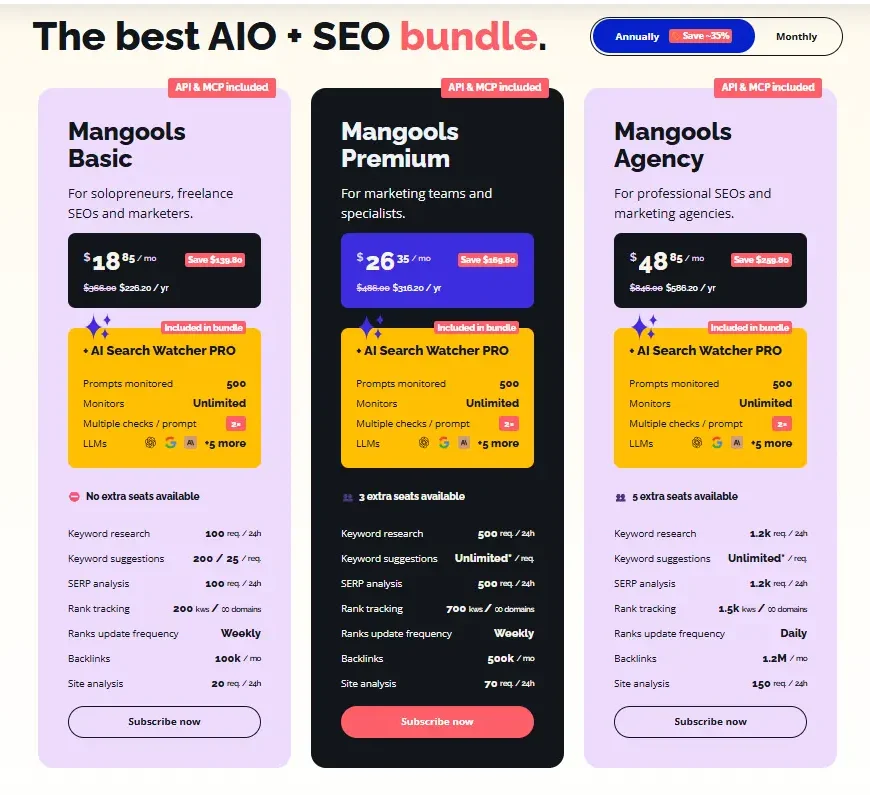
- Basic: $18.85/month billed annually or $30.50/month billed monthly. Covers one user with limits on daily keyword lookups, SERP lookups, and tracked keywords. Best for solo bloggers doing light but regular keyword research.
- Premium: $26.35/month billed annually or $40.50/month billed monthly. Increases all daily limits significantly and adds unlimited keyword suggestions per search—the most popular plan for freelancers handling multiple sites.
- Agency: $48.85/month billed annually or $70.50/month billed monthly. Designed for teams managing multiple client projects, with the highest daily limits and support for multiple users.
All plans come with a 10-day free trial that requires no credit card details. This is genuinely unusual in the SEO tools space and worth taking advantage of before you decide.
The annual versus monthly price difference is worth noting: choosing annual billing on the Basic plan saves you approximately $230 per year compared to paying month to month.
Semrush Pricing
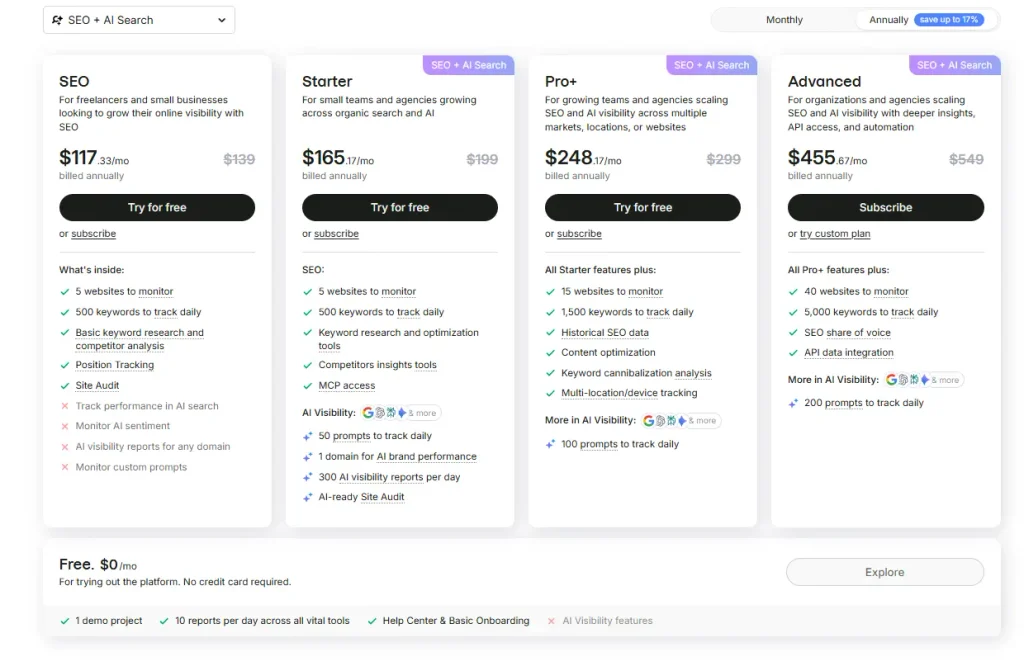
| Plan | Annual Price | Monthly Price | Best For |
|---|---|---|---|
| SEO | $117.33/mo | $139.95/mo | Freelancers and small businesses growing online visibility |
| Starter | $165.17/mo | $199/mo | Small teams and agencies growing across organic search and AI |
| Pro+ | $248.17/mo | $299/mo | Growing teams and agencies scaling SEO and AI visibility across multiple markets, locations, or websites |
| Advanced | $455.67/mo | $549/mo | Organizations and agencies scaling SEO and AI visibility with deeper insights, API access, and automation |
| Free | $0/mo | $0/mo | Trying out the platform, no credit card required |
Mangools Pros and Cons
Pros:
- Extremely beginner-friendly with a clean and intuitive interface across all five tools
- Very affordable entry price at $18.85/month annually
- KWFinder delivers genuinely strong keyword research results for its price point
- 10-day free trial with no credit card requirement
- Browser extension adds real-world workflow speed
- Fast onboarding with minimal learning curve
Cons:
- No native site audit tool, which is a significant gap for diagnosing technical SEO problems
- Five separate apps create workflow fragmentation compared to a unified platform
- Keyword database of around 700 million keywords is significantly smaller than Semrush
- No PPC or advertising competitive data
- No content marketing tools
- Backlink database depth is limited for serious link-building campaigns
Semrush Pros and Cons
Pros:
- The most comprehensive SEO and marketing platform available in one subscription
- 25 billion-plus keyword database provides keyword coverage that smaller tools cannot match
- Full technical site audit with 300-plus checks catches issues other tools miss
- PPC competitor data gives paid search marketers a major intelligence advantage
- Content marketing toolkit reduces the need for additional content tools
- Native integrations with Google Analytics, Google Search Console, and Google Ads
- Semrush Academy provides free certifications and training for upskilling your team
Cons:
- Starting price of $139.95/month is a significant barrier for solo creators and small sites
- Steep learning curve for users who are new to professional SEO tooling
- The breadth of features can feel overwhelming when you only need a fraction of them
- Some tools require add-on subscriptions beyond the base plan cost
Compare Semrush vs Mangools: Feature-by-Feature
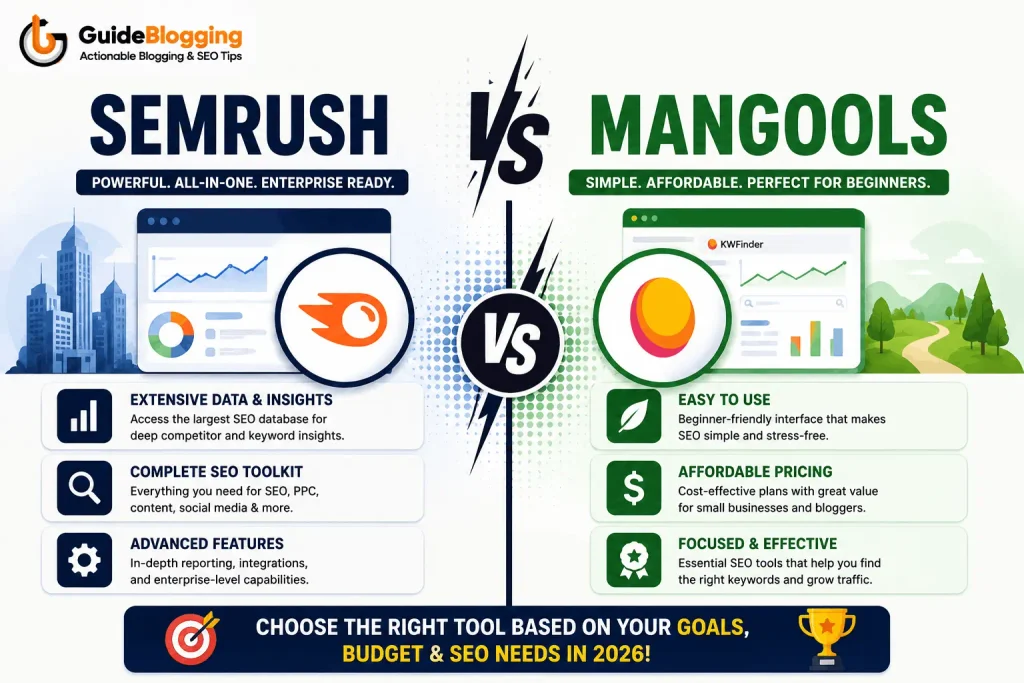
1. Keyword Research
Semrush approaches keyword research as a data science problem. The Keyword Magic Tool pulls from over 25 billion keywords, lets you filter by search intent classification, groups suggestions into semantic clusters, and provides volume trend data across 142 countries.
When a competitor published a keyword research test comparing the two tools, searching a seed keyword in Semrush with a difficulty filter below 20% returned over 100 keyword ideas. The same search in Mangools returned 3.
Mangools takes a different approach. KWFinder is designed to surface the most usable keyword opportunities quickly rather than giving you the most data.
The color-coded difficulty score (green for easy, orange for medium, red for hard) makes opportunity assessment instant, and the inline SERP preview shows you what you are up against without requiring additional clicks.
For a blogger doing focused research on a manageable content plan, this speed is genuinely valuable.
Head-to-head: Semrush wins on raw database size, intent classification, clustering, and filtering capability. Mangools wins on interface speed and accessibility for users who find enterprise tools overwhelming.
Winner: Semrush for depth and scale. Mangools for simplicity and speed.
Also Read: 10 Best Keywords Everywhere Alternatives in 2026 (Free & Paid)
2. Backlink Analysis
Semrush has one of the largest backlink databases in the industry. The Backlink Analytics suite shows the full profile for any domain, tracks link velocity over time, scores toxic links, analyzes anchor text distribution, and lets you run a Backlink Gap analysis comparing your link profile against up to four competitors simultaneously.
The Backlink Audit tool specifically helps you identify links that may be hurting your rankings and build a disavow file if needed.
Mangools handles backlinks through LinkMiner, which gives you referring domain counts, anchor text distribution, and link strength metrics for any domain or page.
It is functional for quick checks and for identifying potential outreach targets. What it does not give you is the depth needed for a serious link-building campaign: no toxic link detection, no velocity tracking, no multi-competitor comparison, and a significantly smaller underlying database.
Head-to-head: Semrush wins decisively. LinkMiner is not a replacement for Semrush’s backlink suite for anyone running active link-building campaigns.
Winner: Semrush
3. Technical SEO and Site Audit
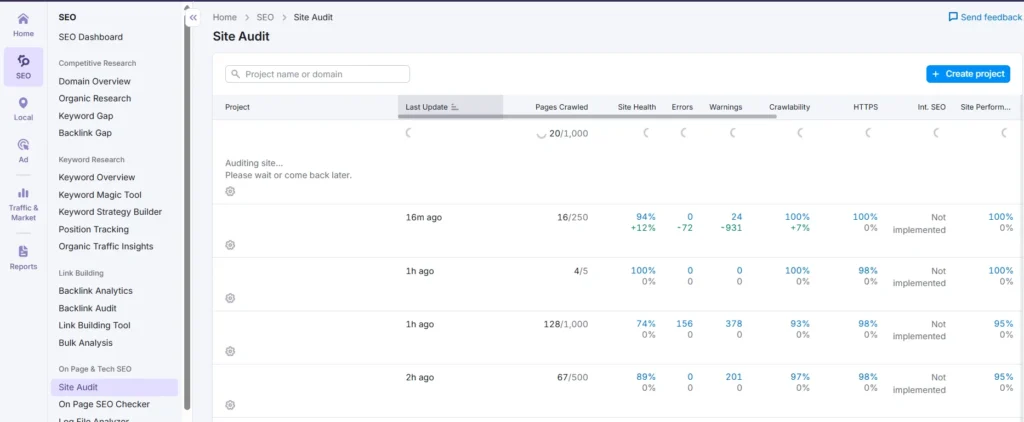
Semrush’s Site Audit tool is one of the most comprehensive technical crawl tools available in any SEO platform. It checks for issues across 300-plus technical parameters covering crawlability, indexability, page speed, Core Web Vitals performance, broken internal and external links, redirect chains, duplicate content, missing or thin meta tags, structured data errors, and internal linking gaps.
The output is organized into priority levels, so you know which issues to fix first.
Mangools has no native site audit tool. SiteProfiler gives you a basic domain metrics overview, but it is not a crawl-based technical analysis.
If you need to diagnose why a page is not ranking or find the technical reasons a new site is struggling to get indexed, Mangools cannot answer those questions directly.
Head-to-head: Semrush wins outright. This is the largest capability gap between the two tools and the most important one to understand before choosing. If technical SEO is part of your workflow, Mangools requires you to use a separate tool for this function entirely.
Winner: Semrush (no contest)
4. Rank Tracking
Semrush’s Position Tracking tool provides daily ranking updates with the ability to track across multiple geographic locations and device types in the same project.
You can add competitor domains alongside your own and see their rankings for your target keywords side by side.
The tool also tracks your presence in SERP features like featured snippets, local packs, and People Also Ask boxes, and calculates an overall visibility percentage.
Mangools’ SERPWatcher handles rank tracking with daily position updates and presents the data in clean trend charts that are genuinely easy to interpret.
For a solo site owner tracking a defined set of target keywords, SERPWatcher does everything you need with significantly less setup time. The interface does not overwhelm you with data points that are not relevant to a one-person operation.
Head-to-head: Both tools deliver the core function reliably. Semrush adds more granular competitor tracking and location-specific data. Mangools is faster to set up and easier to read for straightforward rank monitoring.
Winner: Tie for most use cases
5. Content Marketing

Semrush’s content marketing toolkit is a comprehensive set of tools that covers the full content production cycle. Topic Research helps you find ideas based on real search trends.
The SEO Writing Assistant gives real-time feedback on your draft, checking reading level, tone, keyword optimization, and originality as you write.
Content Audit evaluates your existing published pages. Post Tracking monitors how individual articles perform over time. Brand Monitoring tracks mentions of your business name across the web.
Mangools has no content marketing tools at all.
This is not a limitation of a specific plan; it is simply not part of what Mangools is built to do.
Head-to-head: Semrush wins completely. If content marketing tooling is important to your workflow, this is one of the clearest differentiators between the two platforms.
Winner: Semrush (Mangools has nothing in this category)
6. Competitor Analysis
Semrush gives you a genuinely deep competitor intelligence system. Traffic Analytics estimates actual monthly visit volumes for any domain.
The Keyword Gap tool shows every keyword your competitors rank for that you do not, organized by opportunity. Backlink Gap does the same for link profiles.
Advertising Research reveals competitors’ paid keyword strategies and ad copy. Market Explorer visualizes your entire competitive landscape in one view.
Mangools approaches competitor analysis through SiteProfiler for quick domain overviews and SERPChecker for evaluating who ranks for specific keywords.
KWFinder allows you to enter a competitor’s URL to see which keywords that page ranks for, which is a practical workaround for basic competitive keyword research.
But the scope stops there. There is no traffic estimation, no keyword gap workflow, no paid competitive data, and no multi-competitor comparison at scale.
Head-to-head: Semrush is significantly more capable for competitive research across all dimensions. Mangools is adequate for quick single-competitor checks but cannot support the kind of systematic competitive analysis that agencies and serious content operators need.
Winner: Semrush
Also Read: Ahrefs vs KWFinder 2026: Which Keyword Research Tool Should You Choose?
7. PPC and Advertising Data
Semrush provides PPC keyword research, competitor ad copy analysis, display advertising intelligence, and Google Shopping data.
For any business running paid search alongside organic SEO, this means you can see exactly what your competitors are spending, what keywords they are bidding on, what their ad creative looks like, and where their display ads appear across the web.
Mangools has no PPC data at any plan level. This is a categorical difference, not a feature depth difference.
Winner: Semrush (Mangools has nothing in this category)
Free Tools and Trial Comparison
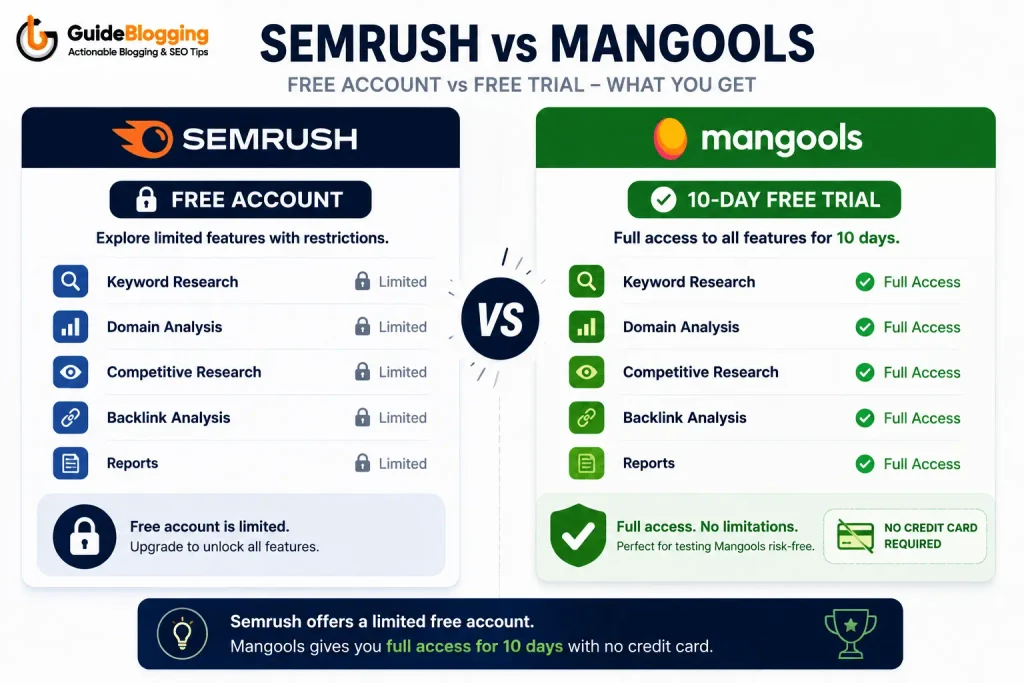
- Semrush free account: Semrush offers a permanent free account that does not expire. Within it, you get limited keyword searches per day across the keyword research and backlink tools, restricted reporting, and no access to the Site Audit tool or historical data. The free account is useful for getting familiar with the interface and running occasional queries, but it is not a workable free option for ongoing professional use.
- Mangools free trial: The 10-day trial gives you full access to all five Mangools tools within daily search limits. No credit card is required to start. This is significantly more generous than Semrush’s permanent free account in terms of giving you a genuine sense of the product before committing.
Verdict: Mangools wins on trial generosity. Semrush’s free account is available indefinitely, but it gives you a frustratingly limited experience of what the paid tool actually does.
Mangools’ 10-day trial lets you run real keyword research and rank tracking before you spend a dollar.
Customer Support Comparison
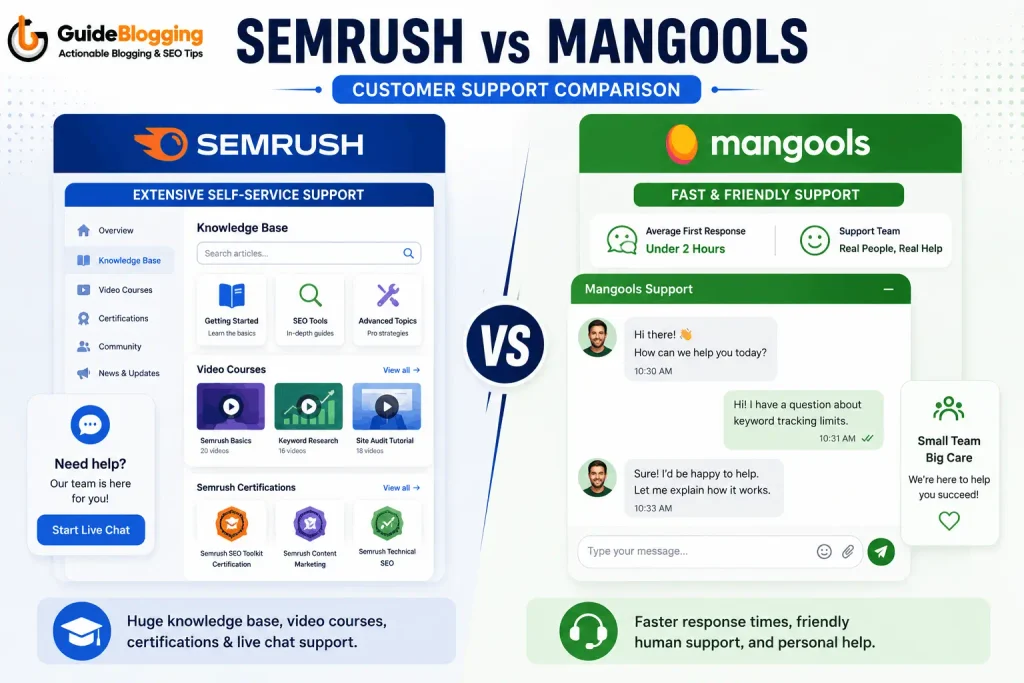
Semrush: Live chat support, email support, an extensive self-service knowledge base, the Semrush Academy with free certifications and structured courses across SEO topics, an active YouTube channel with tutorial content, and a large community forum where you can get answers from other users. The breadth of Semrush’s educational resources is genuinely one of its underappreciated advantages, particularly for marketers who want to build their skills while using the tool.
Mangools: Live chat and email support that users consistently rate as fast, personal, and helpful. The smaller team behind Mangools means you are more likely to get a direct, useful answer quickly rather than a templated response. The self-service resource library is smaller than Semrush’s but covers the essentials well.
Winner: Mangools for personal responsiveness and speed. Semrush for breadth of educational resources and self-service options.
Semrush vs Mangools: Which One Should You Choose?
Choose Semrush If:
You manage SEO for multiple client sites or a large website with significant technical issues that need systematic diagnosis and tracking.
You run paid search campaigns alongside organic SEO and want competitive PPC intelligence in the same platform as your keyword research.
You need content marketing tools integrated into your SEO workflow rather than subscribing to a separate content optimization tool.
Your monthly budget allows for $139.95/ per month or more, and the return on investment comes from the breadth of capability across multiple marketing functions, not just keyword research.
You are running an agency or in-house marketing team that needs collaboration features, white-label reporting, and the ability to manage multiple client projects inside one account.
Choose Mangools If:
You are a blogger, affiliate marketer, or freelancer whose primary workflow involves keyword research and rank tracking and not much else.
Your budget is under $50/month, and you want the strongest tool available at that price point. At $29.90/month annually, Mangools has no serious competitor at this level.
You value a clean, beginner-friendly interface over feature depth. If opening a new tool and finding your way around quickly matters to you, Mangools is significantly easier to get started with.
You do not need a technical site audit, PPC competitive intelligence, or content marketing tools built into your SEO platform.
You want to test a tool properly before paying for it. The 10-day free trial with no credit card requirement is the most generous evaluation offer in this comparison.
Can You Use Both Together?
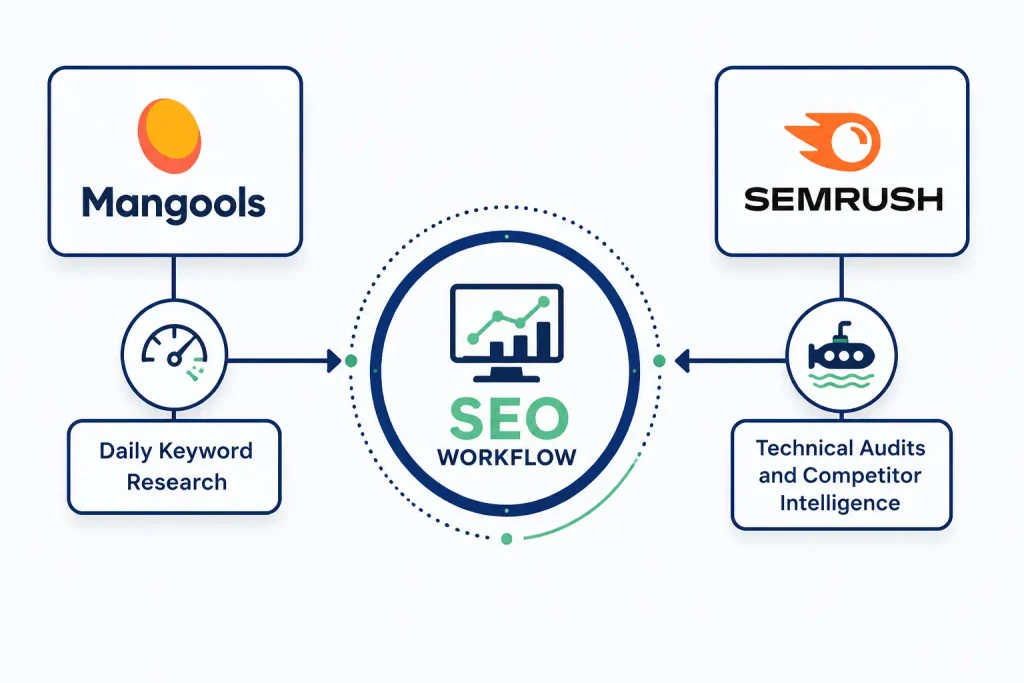
Some experienced SEOs and agencies use Mangools for daily keyword research because the KWFinder interface is faster to work with for quick lookups, and Semrush for technical auditing and competitive intelligence where its database depth and audit capability justify the investment.
This combination is not necessary for most users. It is a workflow that makes sense for larger content operations where the speed of daily keyword research is meaningful enough to justify running two subscriptions.
For most individual users, picking one and committing to it is the right call. The overlap between the two tools is significant enough that running both is a cost decision as much as a capability one.
FAQs On mangools vs semrush
Is Semrush better than Mangools?
Semrush is more powerful and more comprehensive than Mangools across almost every feature category. Whether that makes it “better” for you depends on whether you need that power. For agencies and experienced SEOs managing multiple sites, Semrush is the better tool. For solo bloggers and freelancers focused on keyword research and rank tracking, Mangools delivers more value per dollar spent.
Is Mangools good enough for SEO?
Semrush vs Mangools comes down to your needs. Semrush is the stronger tool for agencies and experienced SEOs who need deep data, technical audits, and PPC intelligence. Mangools is the better pick for bloggers and freelancers who want solid keyword research and rank tracking at a budget-friendly price.
Why is Semrush more expensive than Mangools?
Semrush covers significantly more ground than Mangools. The price difference reflects a 25 billion-plus keyword database (versus roughly 700 million), a full technical crawl audit that Mangools does not have, PPC competitive intelligence, content marketing tools, and a multi-channel competitive analysis suite. Mangools is priced for what it is: a focused keyword research and rank tracking toolkit. Semrush is priced for what it is: a full-scale digital marketing platform.
Can Mangools replace Semrush?
Mangools can replace Semrush for keyword research and rank tracking. It cannot replace Semrush for technical site audits, PPC intelligence, content marketing tools, or deep competitor analysis. The answer depends entirely on which of those capabilities you actually use. Many users who switch from Semrush to Mangools find they were only using a fraction of Semrush’s features anyway.
Which SEO tool is better for beginners?
Mangools is significantly better for beginners. The interface is intuitive from day one, the tools are focused on core tasks, and the price is much less intimidating for someone who is not yet sure how much they will rely on the tool. Semrush’s power comes with a learning curve that beginners often find overwhelming before they are ready for it.
Which tool is better for keyword research: Semrush or Mangools?
Semrush has a larger database and more advanced filtering for keyword research at scale. Mangools has a cleaner interface and faster workflow for keyword research at a simpler level. Both do the job well. The question is whether you need 25 billion keywords or whether 700 million is plenty for your content strategy.
Does Mangools have a site audit tool?
No. Mangools does not include a technical site audit tool at any plan level. SiteProfiler provides a basic domain metrics overview but is not a crawl-based technical analysis. If you need site audit functionality alongside your keyword research, you will need either Semrush or a separate technical SEO tool.
Is Mangools a good alternative to Semrush?
Mangools is a good alternative to Semrush specifically for users who were primarily using Semrush for keyword research and rank tracking. It is not a good alternative for users who relied on Semrush for technical audits, competitor intelligence, or PPC data. Switching from Semrush to Mangools makes sense when you want to reduce costs and you have identified that you are not using the majority of Semrush’s capabilities.
What is the best affordable alternative to Semrush?
Mangools is consistently the strongest affordable alternative at the $30/month price point. For users who need a bit more than Mangools offers but cannot stretch to Semrush, Ubersuggest sits in the middle ground. For users primarily interested in backlink analysis, there are dedicated tools worth exploring as well.
Final Thought On
Semrush vs Mangools tools which is better?
both are good tools. They are not competing for the same user, which is why comparing them directly feels almost unfair in both directions. Semrush undersells Mangools by making it look limited.
Mangools undersells Semrush by making it look overpriced.
The right call is matching the tool to your actual workflow and current budget rather than to whichever feature list sounds more impressive.
If your SEO work is primarily keyword research and rank tracking on a personal or small commercial site, start with Mangools.
If you are managing client work, need technical audits, or want cross-channel competitive intelligence, Semrush is worth the investment.
ALSO READ:
- Ahrefs vs SEMrush 2026: Which SEO Tool Should You Use?
- 20 Off-Page SEO Tactics That Actually Work in 2026 (Complete Guide)
- Google Penalty Checker: How to Check, Fix & Recover from Google Penalties (2026)
- UnfoldVideo Review 2026: Bundle + Coupon + Honest Verdict + Bonuses
- AI Long eBook Creator Review 2026: Features, Pricing, Pros & Cons

10 thoughts on “Semrush vs Mangools (2026): Which SEO Tool Should You Choose?”