
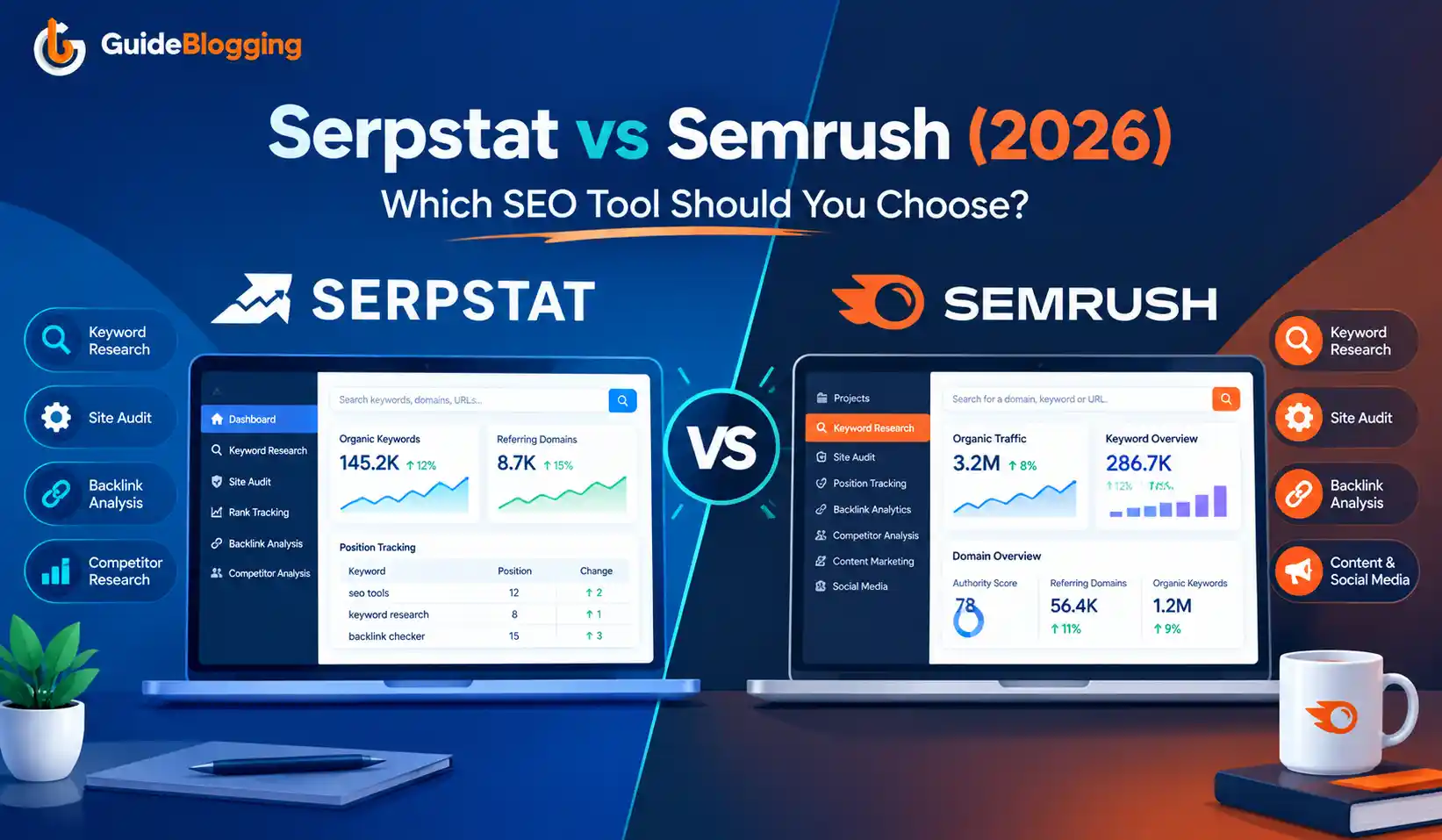
Quick Answer: Semrush is the more powerful, enterprise-grade platform starting at $139.95/month, best for agencies and marketers who need PPC data, AI visibility tracking, and advanced content tools. Serpstat starts at $50/month and is the better choice for budget-conscious SEOs and small agencies who need solid keyword research, rank tracking, and technical audits at a significantly lower cost.
If your shortlist for an SEO platform has come down to Serpstat vs Semrush, you are comparing two genuinely capable tools that serve different users at very different price points.
Both platforms cover the core SEO workflow: keyword research, rank tracking, backlink analysis, and site auditing. Where they diverge is in depth, data scale, and the additional capabilities beyond traditional SEO. Semrush is broader and more powerful. Serpstat is more affordable and focused.
The right choice depends entirely on your workflow, team size, budget, and whether you need features like PPC intelligence and AI search visibility tracking as part of your daily operations.
This guide gives you a complete breakdown of both tools individually before comparing them head to head across every feature category so you can make the decision in one read.
Serpstat vs Semrush at a Glance
| Serpstat | Semrush | |
|---|---|---|
| Best For | Budget SEOs, small agencies, freelancers | Agencies, enterprise, experienced marketers |
| Starting Price | $50/month ($42/month annual) | $139.95/month ($117.33/month annual) |
| Keyword Database | 7 billion plus keywords | 25 billion plus keywords |
| Site Audit | Solid, reliable JS support | Advanced, 300 plus checks, full JS rendering |
| Backlink Analysis | Solid mid-range, 1.1 trillion backlinks | Enterprise-grade, 43 trillion backlinks |
| PPC Data | Limited | Full advertising research suite |
| AI Visibility Tracking | Basic detection only | Full AI Visibility Toolkit ($99/mo add-on) |
| Multi-User Seats | Included in Team plans | $80/month per extra user |
| API Access | Included from Team plan ($100/mo) | Business plan only ($499.95/mo) |
| Free Option | 7-day free trial | Limited free account |
What Is Serpstat?
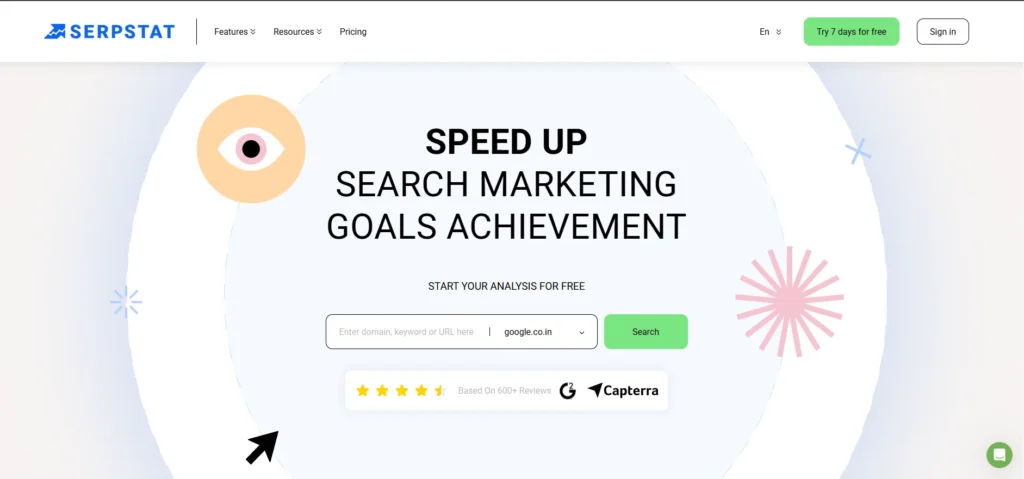
Serpstat launched in 2013 as a keyword research tool and has since grown into a full SEO platform covering keyword research, rank tracking, backlink analysis, site auditing, and competitor research. \
It is most commonly used by small to mid-sized agencies, freelance SEOs, and in-house marketing teams who need comprehensive SEO data at a price significantly lower than enterprise competitors.
With over 1.1 million users worldwide and a 4.6 out of 5 average rating across major review platforms, it has established genuine credibility as the mid-range option between lightweight tools like Mangools and premium platforms like Semrush and Ahrefs.
What Is SEMrush?
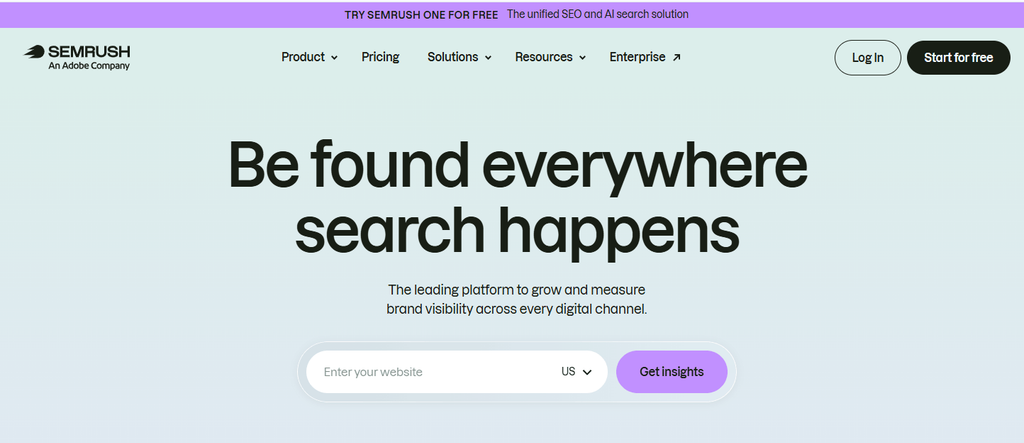
Semrush launched in 2008 and has grown into one of the most comprehensive digital marketing platforms available globally, used by over 10 million marketing professionals.
Beyond SEO, Semrush covers PPC research, content marketing, social media management, competitive intelligence, and AI search visibility tracking.
It is the platform most marketing agencies and in-house teams graduate to when they need depth across multiple channels and a single unified workspace that eliminates the need for separate tools handling content, advertising research, and competitive analysis independently.
Serpstat Key Features
1. Keyword Research
Serpstat’s keyword database covers 7 billion plus keywords across 230 Google databases, with performance that holds up well for most blogging, affiliate marketing, and small agency workflows. The standout feature is its keyword clustering tool, which automatically groups related keywords by topic, saving significant manual work in content planning and internal linking strategy. A question keyword filter surfaces user intent questions for content ideation, and search intent classification is available though less granular than Semrush’s four-category system.
2. Rank Tracking
Daily position tracking runs across Google and Bing with desktop and mobile tracking supported simultaneously. Local rank tracking is available down to city and region level.
Competitor rank comparison sits within the same dashboard alongside a visibility score that shows your overall SERP presence across your full tracked keyword set. Scheduling is flexible with options for daily, weekly, or custom frequency updates depending on your monitoring needs.
3. Backlink Analysis
Serpstat’s backlink database covers 1.1 trillion plus backlinks with referring domain tracking, domain trust scores, anchor text distribution reports, and new and lost link monitoring.
Toxic backlink identification is included for disavow file management. The database is updated regularly and is adequate for routine link auditing and competitor backlink research, though its index size is smaller than Semrush’s and detection speed for newly acquired or lost links is slower.
4. Site Audit
The full technical crawl covers crawlability, indexability, broken links, redirect chains, duplicate content, missing meta tags, and on-page optimization issues.
JavaScript rendering handles standard frameworks reliably.
Issue severity prioritization with fix recommendations helps teams work through technical debt in the right order, and scheduled audit runs with change monitoring keep ongoing site health maintenance manageable without manual re-triggering.
5. Competitor Analysis
Domain versus domain comparison reveals keyword overlap, traffic share, and competitor visibility across search results.
PPC competitor research is available but limited in depth compared to Semrush’s dedicated advertising research suite. The traffic share analysis gives a practical overview of how competitive a niche is before committing content resources to it.
5. API Access
API access is included in the Team plan at $100 per month, which is one of Serpstat’s most significant pricing advantages.
Semrush gates API access behind the Business plan at $499.95 per month. For teams pulling keyword or ranking data programmatically into custom dashboards or automated reporting workflows, this difference is not a minor consideration. It is a $400 per month difference at the access threshold.
Semrush Key Features
1. Keyword Research
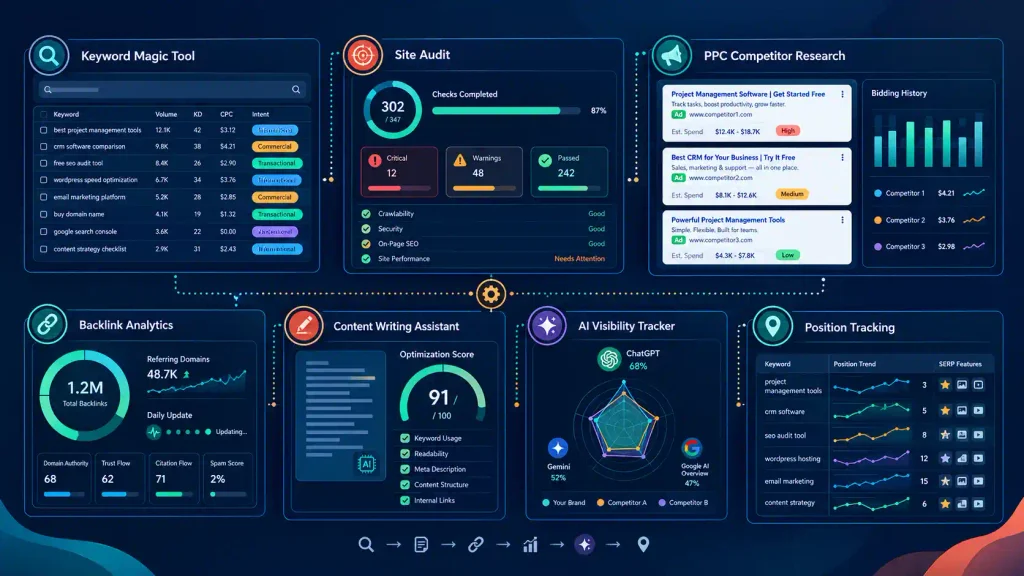
The Keyword Magic Tool draws from 25 billion plus keywords spanning 140 countries with intent classification covering four types: informational, commercial, transactional, and navigational.
Keyword difficulty scoring is calibrated to the actual backlink profiles of top-ranking pages, making it more precise than Serpstat’s scoring for competitive keyword analysis. Keyword clustering and topic grouping are available alongside historical volume trend data going back multiple years, which is locked behind the Guru plan and above.
2. Rank Tracking
Daily position tracking with device-specific and location-specific data runs down to city level. Competitor rank monitoring for the same keyword set sits alongside SERP feature tracking that shows whether your pages appear in featured snippets, People Also Ask boxes, local packs, or image results. A visibility percentage metric across the entire tracked keyword set gives agencies a single number to report overall search presence trends to clients.
3. Backlink Analysis
Semrush operates one of the largest backlink databases in the industry with 43 trillion backlinks and daily index updates. Toxic backlink identification with severity scoring, link gap analysis comparing your profile against up to five competitors simultaneously, and direct disavow file export are all included.
For agencies running active link building campaigns where detection speed and competitive depth matter, this backlink suite is materially more capable than Serpstat’s offering.
4. Site Audit
The full technical crawl covers 300 plus checks with advanced JavaScript rendering for React, Vue, and Angular frameworks, which is meaningfully more thorough than Serpstat’s standard JS support for complex modern web applications.
Core Web Vitals data integrates directly into the audit dashboard. Scheduled crawls with email alerts for new critical issues make ongoing site health monitoring practical without manual re-triggering.
5. Content Marketing Toolkit
Topic Research surfaces content ideas based on real search trends. The SEO Writing Assistant provides real-time content optimization feedback as you draft. Content Audit evaluates your existing published pages against current ranking standards. Post tracking monitors published content performance over time. This entire content toolkit has no equivalent in Serpstat at a comparable depth.
6. PPC and Advertising Research
Competitor ad copy history, estimated spend, Google Shopping product ad research, and display advertising analysis are all included.
PPC keyword research is separate from organic keyword data, giving a complete dual-channel competitive picture. This advertising intelligence capability is a genuine category differentiator that Serpstat cannot match.
7. AI Visibility Tracking
Semrush’s AI Visibility Toolkit tracks your brand and content presence across Google AI Overviews, Bing Copilot, ChatGPT, and Gemini.
It shows which of your pages are being cited in AI-generated answers, how frequently you appear, and how that citation frequency changes over time.
Custom prompt tracking allows you to monitor specific queries relevant to your business.
Semrush also added Google AI Mode tracking to its Position Tracking tool in 2026, where AI Overview citations count as top-ranking positions in your campaign reporting.
No equivalent feature exists in Serpstat at this depth in 2026.
Serpstat Pricing (Verified June 2026)
| Plan | Monthly Billing | Annual Billing (per month) |
|---|---|---|
| Individual | $50/month | ~$42/month |
| Team | $100/month | ~$83/month |
| Team x2 | $169/month | ~$128/month |
| Agency | $410/month | ~$342/month |
Note: Serpstat does not offer a permanent free plan. A 7-day free trial is available with a $1 verification charge refunded within 30 minutes.
Semrush Pricing (Verified August 2026)
| Plan | Monthly Billing | Annual Billing (per month) |
|---|---|---|
| Pro | $139.95/month | $117.33/month |
| Guru | $249.95/month | $208.33/month |
| Business | $499.95/month | $416.66/month |
Extra user seats cost $80 per month per additional user beyond the included seats, which becomes a significant cost driver for agencies with larger teams compared to Serpstat’s team-included pricing model.
The AI Visibility Toolkit is a $99 per month add-on to any base plan. Semrush also offers a Semrush One bundle starting at $199 per month that pairs the SEO toolkit with AI visibility features in a single subscription for teams where both are needed.
Serpstat Pros and Cons
Pros:
- Most affordable entry point of any full-suite SEO platform at $50/month
- API access included from the Team plan, not gated behind enterprise pricing
- Keyword clustering feature is genuinely strong and saves significant content planning time
- Multi-user seats included in team plans rather than charged per additional seat
- 7-day trial allows genuine pre-purchase evaluation across all core tools
- Solid site audit with reliable JavaScript rendering for standard frameworks
Cons:
- Smaller keyword database at 7 billion versus Semrush’s 25 billion
- Limited PPC and advertising competitive research depth
- No dedicated AI Overview visibility tracking at a comparable level to Semrush
- Content marketing tools less advanced than Semrush’s full content toolkit
- Interface improvement ongoing but historically less polished than Semrush
Semrush Pros and Cons
Pros:
- Largest keyword database in the industry at 25 billion plus keywords across 140 countries
- Enterprise-grade backlink analysis with 43 trillion backlinks and daily index updates
- Full PPC competitive research suite with no equivalent in Serpstat
- AI Visibility Toolkit for tracking brand presence in Google AI Overviews, ChatGPT, and Gemini
- Advanced content marketing toolkit including SEO Writing Assistant and Content Audit
- Most comprehensive JavaScript rendering for technically complex modern web applications
- 14-day free trial with full Pro access available
Cons:
- Significantly more expensive at every tier compared to Serpstat
- Extra user seats cost $80 per month each, making team pricing compound quickly
- API access only available on the Business plan at $499.95 per month
- Steeper learning curve for beginners navigating 55 plus integrated tools
- AI Visibility Toolkit costs an additional $99 per month on top of the base plan
Serpstat vs Semrush for Keyword Research
Serpstat Keyword Research
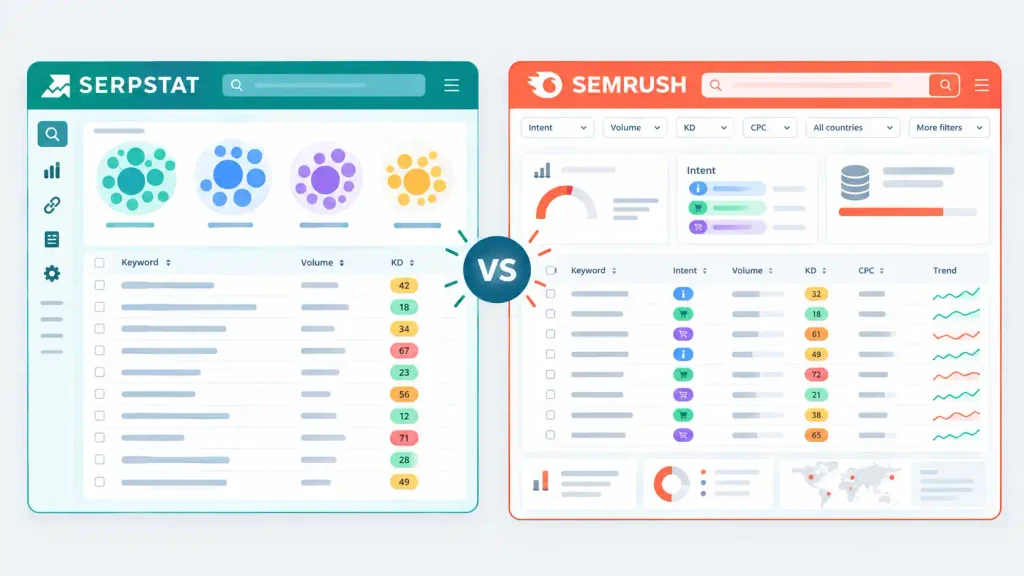
Serpstat’s 7 billion plus keyword database performs solidly for most blogging, affiliate marketing, and small agency keyword research workflows. Its most distinctive feature is keyword clustering, which automatically groups related keywords by topical relevance to accelerate content planning.
The question keyword filter surfaces user intent questions similar to tools like Answer The Public, and search intent classification is available across keyword results.
Where Serpstat begins to show limitations is at the competitive end: on highly contested queries in lucrative niches, the smaller database produces thinner long-tail suggestions and less precise keyword difficulty scoring than Semrush.
Also Read: Ahrefs vs KWFinder 2026: Which Keyword Research Tool Should You Choose?
Semrush Keyword Research
Semrush’s Keyword Magic Tool draws from 25 billion plus keywords, more than three times Serpstat’s database.
Four category intent classification covering informational, commercial, transactional, and navigational intent is reliable and accurate, making it genuinely useful for matching content format to search intent rather than just finding keywords.
Keyword difficulty scoring calibrated to actual backlink profiles of top-ranking pages produces more accurate assessments of competitive difficulty than Serpstat’s scoring at the hard end of the keyword spectrum.
Historical volume trend data going back multiple years on Guru and above adds a strategic dimension to keyword selection that Serpstat cannot provide.
Verdict
Semrush wins on database size, filtering depth, and intent accuracy at the competitive end of keyword research. Serpstat wins on keyword clustering usability and price.
For bloggers and affiliate marketers researching long-tail keywords in moderately competitive niches, Serpstat’s database is more than adequate and its clustering feature saves genuine time.
For agencies running competitive research across multiple countries and needing accurate KD scores for highly competitive terms, Semrush produces materially better results.
Serpstat vs Semrush: Backlink Analysis
Serpstat Backlink Analysis
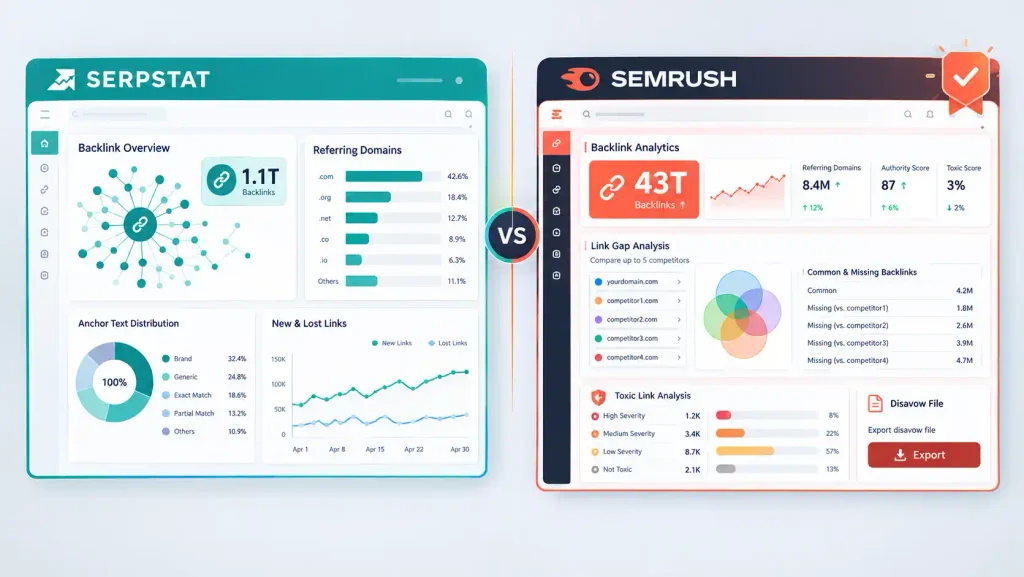
Serpstat’s 1.1 trillion backlink database is reliable for routine link auditing: referring domain tracking, anchor text distribution, and new and lost link monitoring all function well.
Toxic backlink identification works adequately for standard disavow management.
The database updates regularly but detection speed for newly acquired or lost links is slower than Semrush, and its overall coverage is smaller.
For monthly spot-checks and competitive link profiling at a high level, Serpstat delivers sufficient data without the premium cost.
Semrush Backlink Analysis
Semrush’s 43 trillion backlink index with daily updates is one of the largest in the SEO industry. Link gap analysis comparing your backlink profile against up to five competitors simultaneously goes significantly beyond what Serpstat’s link tools can produce.
The Backlink Audit generates disavow files directly and scores toxic links by severity rather than just flagging them. For agencies running active link building campaigns where detection speed, comprehensive coverage, and competitive gap analysis matter in daily workflows, Semrush’s backlink suite is a different category of tool.
Verdict: Backlink Analysis
Semrush wins on database size, detection speed, and competitive analysis depth. Serpstat is adequate for routine monthly backlink audits and basic competitor link research. If backlink analysis is a daily operational workflow rather than an occasional check, Semrush’s depth justifies the price difference for that specific use case.
Serpstat vs Semrush: Site Audit
Serpstat Site Audit
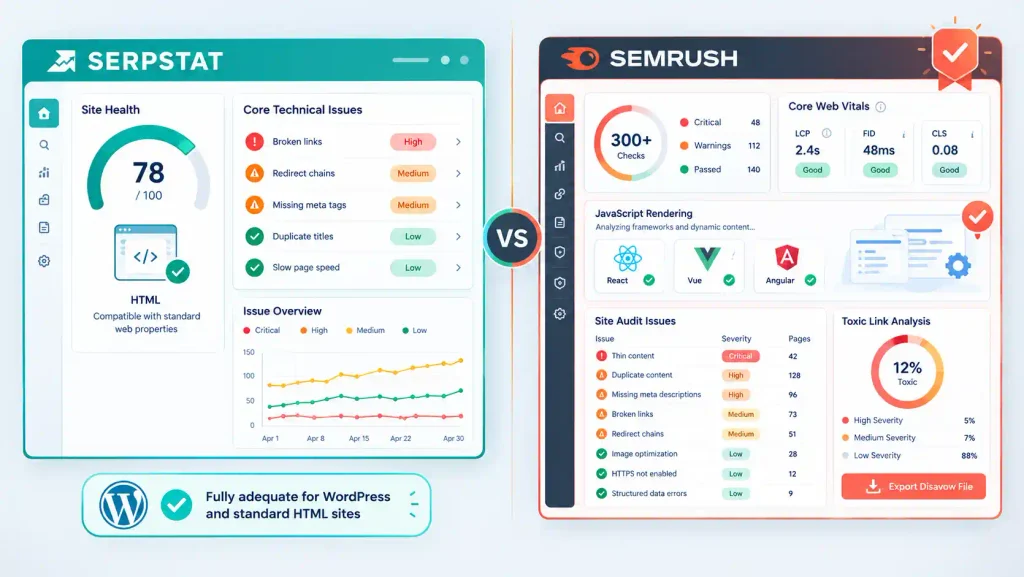
Serpstat’s site audit covers the core technical SEO requirements reliably: crawlability, indexability, broken links, redirect chains, duplicate content, missing meta tags, and page speed indicators.
JavaScript rendering handles standard JS frameworks adequately. Scheduled audit runs and issue severity prioritization make it a practical tool for maintaining ongoing site health, and the crawl depth is sufficient for most WordPress and standard HTML-based web properties.
Semrush Site Audit
Semrush Site Audit runs 300 plus technical checks and includes full JavaScript rendering for React, Vue, and Angular frameworks, which is an important practical advantage for sites built on modern frontend JavaScript where Serpstat’s JS support can miss crawl issues that affect indexability.
Core Web Vitals data integrates directly into the audit dashboard alongside issue prioritization. For technically complex sites on modern frameworks, Semrush catches issues that Serpstat may overlook due to shallower JavaScript parsing.
Verdict: Site Audit
Both tools handle standard site auditing reliably for WordPress sites and conventional HTML web properties. Semrush wins for technically complex sites using modern JavaScript frameworks where full JS rendering produces meaningfully more complete crawl results. Serpstat is fully adequate for the majority of blogging and small business site audits.
Serpstat vs Semrush: Rank Tracking
Serpstat Rank Tracking
Daily position updates across Google and Bing with desktop and mobile tracking, local rank tracking by city or region, and competitor rank comparison are all included and function reliably.
The visibility score metric provides an overall SERP presence picture across the tracked keyword set. Scheduling flexibility makes it practical to configure different update frequencies for different projects based on monitoring priority.
Semrush Rank Tracking
Position Tracking in Semrush adds SERP feature tracking showing whether pages appear in featured snippets, People Also Ask, local packs, or image results alongside standard position data.
Device and location targeting goes down to city level, and competitor tracking for the same keyword set is more granular than Serpstat’s.
For agencies managing local SEO campaigns across multiple locations or reporting SERP feature presence to clients, Semrush’s rank tracking delivers meaningfully more detailed data.
Verdict: Rank Tracking
Both tools cover the core rank tracking need well for standard single-site monitoring. Semrush adds meaningful depth for agencies managing local SEO, SERP feature tracking, and multi-location campaigns. For straightforward keyword position monitoring where the basic metrics are all that is needed, Serpstat performs equivalently at a significantly lower price.
Also Read: Best SEO Tools for Agencies (Free & Paid Picks for 2026)
Serpstat vs Semrush: Competitive Analysis
Serpstat Competitive Analysis
Domain versus domain comparison shows keyword overlap, traffic share, and competitor visibility in organic search. Keyword gap analysis identifies what competitors rank for that you currently do not. The competitor analysis covers organic SEO competitive intelligence reliably for most small agency use cases. PPC competitor research is present but limited to basic data compared to Semrush’s full advertising research infrastructure.
Semrush Competitive Analysis
Semrush’s competitive intelligence spans organic SEO, PPC, display advertising, and market landscape mapping through Market Explorer.
Traffic Analytics estimates competitor website traffic by source. The advertising research suite reveals competitor ad copy history, estimated spend, and keyword targeting strategies going back years.
Keyword gap and backlink gap analyses run simultaneously against multiple competitors. This depth of competitive intelligence has no equivalent in Serpstat for agencies running paid search alongside organic SEO.
Verdict: Competitive Analysis
Semrush wins significantly on competitive intelligence, particularly for the PPC and advertising research layer. Serpstat’s competitor research is adequate for organic SEO gap analysis but cannot match the advertising intelligence capability that makes Semrush the preferred tool for agencies managing both paid and organic channels.
AI Overview and AI Search Tracking: The 2026 Differentiator
Google AI Overviews now appear for an estimated 27 to 32 percent of all tracked searches in 2026, according to research published by Serpstat itself across 30 million SERPs.
Whether your content appears in these AI-generated answers is increasingly as important as traditional ranking position for informational queries, and the tools that track this visibility are becoming a meaningful differentiator in what SEO platforms can deliver to clients.
What Serpstat Offers for AI Search Tracking
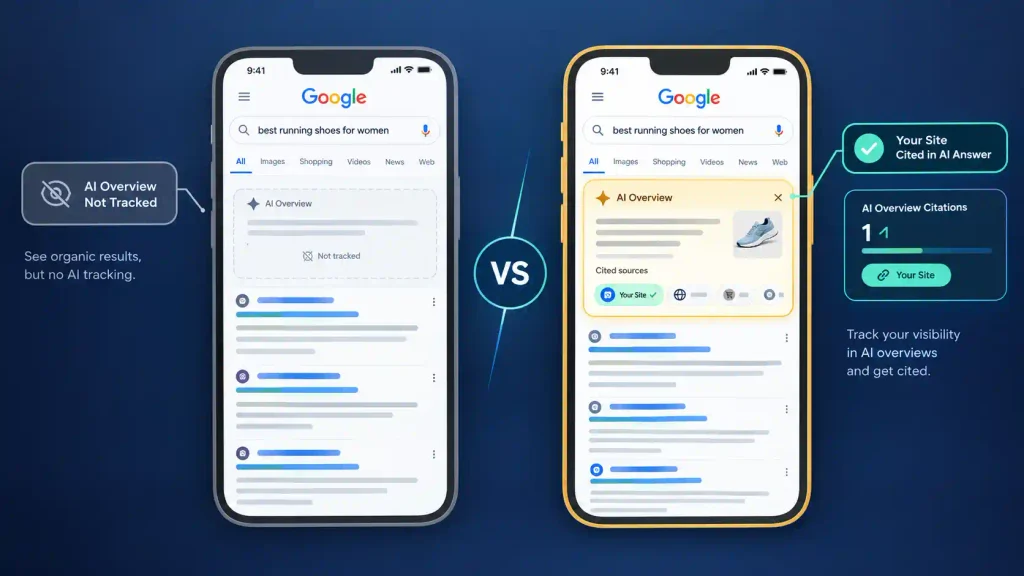
Serpstat detects AI Overview presence in its rank tracking and keyword research modules, marking AIO-triggered keywords with an indicator flag.
Their own research across 30 million SERPs has produced substantial data on AI Overview adoption and volatility patterns. They have also launched LLM Brand Monitor as a separate product for tracking brand mentions in AI responses.
The practical limitation is meaningful: Serpstat tells you that an AI Overview appeared for a keyword. It does not tell you whether your specific content is being cited inside that AI Overview, how your brand performs across ChatGPT or Gemini, or what prompts trigger your competitors to appear in AI responses.
For content creators and affiliate marketers whose informational content is most likely to appear in AI Overviews, this monitoring gap matters.
What Semrush Offers for AI Search Tracking
Semrush’s AI Visibility Toolkit tracks your brand and content presence across ChatGPT, Google AI Overviews, Perplexity, and Gemini as a $99 per month add-on to any base plan.
You configure custom prompts between 25 and 200 depending on your plan level, track daily visibility scores, and see exactly which competitor domains are cited in your target queries and how your citation frequency changes over time.
Semrush also added Google AI Mode tracking directly into Position Tracking in 2026. When your content is cited in a Google AI Overview, it registers as a top-ranking position in your tracking campaign, connecting AI visibility directly to the rank tracking workflow SEOs already operate.
This allows agencies to report AI Overview presence alongside traditional SERP position in a single unified campaign view.
Verdict: Semrush wins outright on AI search visibility tracking. The gap between Serpstat’s basic AIO flag detection and Semrush’s full AI Visibility Toolkit is substantive, not marginal.
For content sites and bloggers publishing informational content where AI Overview appearances are becoming a meaningful traffic factor, this is a differentiator that will grow in importance through 2026 and beyond.
Serpstat vs Semrush: Pricing Comparison
| Serpstat | Semrush | |
|---|---|---|
| Entry plan | $50/month ($42/month annual) | $139.95/month ($117.33/month annual) |
| Mid plan | $100/month ($83/month annual) | $249.95/month ($208.33/month annual) |
| Upper-mid plan | $169/month ($128/month annual) | N/A |
| Agency/Business | $410/month ($342/month annual) | $499.95/month ($416.66/month annual) |
| Extra users | Included in Team plans | $80/month per additional user |
| API access | Included from Team ($100/mo) | Business plan only ($499.95/mo) |
| AI tracking | Basic AIO detection included | $99/month add-on |
| Free option | 7-day trial | Limited free account |
Customer Support Comparison
Serpstat Support
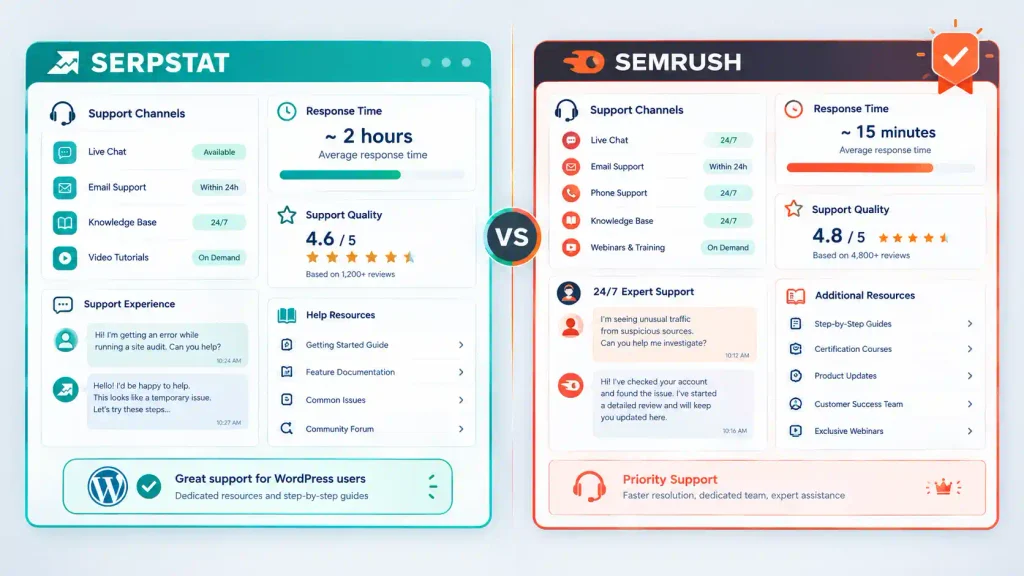
Live chat support, email support, and a self-service knowledge base covering core features. Response times are generally good and the smaller user base means interactions with support staff tend to be more direct and personal. Documentation covers all core platform features adequately for standard use cases.
Semrush Support
Live chat, email support, Semrush Academy with free certifications, an extensive self-service knowledge base, and an active YouTube channel with tutorial content. The breadth of self-directed learning resources is the most comprehensive in the SEO tool market. Support response time can be slower due to the volume of a 10 million plus user base, but the self-service resources typically answer most questions before live support is needed.
Verdict: Serpstat for personal responsiveness and faster live support interactions. Semrush for the most comprehensive self-directed learning library in the SEO software category.
Which Tool Should You Choose?
Choose Serpstat If:
Your budget is under $100 per month and you need a solid all-in-one SEO platform that covers keyword research, rank tracking, site auditing, and competitor analysis without paying enterprise pricing for it.
You manage a small agency with multiple team members who need shared platform access without paying $80 per month per additional user seat.
Your primary workflow is organic SEO with no significant PPC component that requires advertising intelligence.
You need API access included in your plan without crossing into a $499 per month tier.
You are building content or affiliate sites where traditional SEO fundamentals cover 90 percent of what you need to execute and measure.
Choose Semrush If:
You manage SEO and PPC together and need both organic and advertising competitive intelligence in a single platform.
You need AI Overview and AI search visibility tracking as part of your standard reporting to clients or internal stakeholders.
You work with technically complex sites on React, Vue, or Angular frameworks that require full JavaScript rendering in site audits to catch all crawl issues.
Your team requires the most comprehensive competitive intelligence available across organic, paid, display, and market landscape data.
Your organization’s budget can support the higher entry price and the platform’s feature breadth genuinely replaces or exceeds what multiple separate tools would cost combined.
FAQs About Serpstat vs Semrush
Is Serpstat good for SEO?
Yes. Serpstat is genuinely good for keyword research, rank tracking, technical auditing, and organic competitor analysis. It covers the core SEO workflow effectively for bloggers, freelance SEOs, and small agencies. Its practical limitations are in PPC research depth, AI search visibility tracking, and advanced JavaScript rendering compared to Semrush.
Is Serpstat better than Semrush?
Serpstat is not more capable than Semrush overall, but it delivers better value for users who do not need Semrush’s advanced capabilities. Serpstat offers a strong SEO toolkit starting at $50 per month versus Semrush’s $139.95 entry point. Semrush covers more features, has a larger database, and includes tools that Serpstat simply does not offer in 2026, particularly in AI search tracking and PPC intelligence.
What is the price of Semrush vs Serpstat?
Serpstat starts at $50 per month ($42 per month on annual billing). Its most popular team plan is $100 per month. Semrush starts at $139.95 per month ($117.33 per month annual) for the Pro plan. Extra user seats on Semrush cost $80 per month per user, compared to Serpstat’s team-included pricing model.
Is Serpstat a good alternative to Semrush?
For organic SEO workflows on a budget, yes. Serpstat covers keyword research, rank tracking, backlink analysis, and site auditing at a lower price point with API access included from the Team plan. It is not a suitable alternative if you specifically need PPC intelligence, AI Overview citation tracking, advanced JavaScript rendering, or the content marketing tools that Semrush provides.
Which is better for keyword research: Serpstat or Semrush?
Semrush has a larger database at 25 billion versus Serpstat’s 7 billion keywords and more precise intent classification. Serpstat’s keyword clustering feature is genuinely strong and often more intuitive for content planning workflows. For most blogging and affiliate marketing keyword research, Serpstat’s database is adequate. For competitive agency-level research requiring precise keyword difficulty scores on highly contested terms, Semrush produces better results.
Does Serpstat track Google AI Overviews?
Serpstat detects when AI Overviews appear for tracked keywords and flags them in reports, and has published substantial research on AIO patterns across 30 million SERPs. However, it does not show whether your specific content is cited inside those AI Overviews or track brand presence across ChatGPT, Gemini, and Perplexity at the depth Semrush’s AI Visibility Toolkit provides.
Does Semrush have an AI search tracker?
Yes. Semrush’s AI Visibility Toolkit, available as a $99 per month add-on, tracks brand presence across ChatGPT, Google AI Overviews, Perplexity, and Gemini. It also added Google AI Mode tracking to Position Tracking in 2026, where AI Overview citations count as top-ranking positions in your tracking campaigns.
What is the best alternative to both Serpstat and Semrush?
SE Ranking is the strongest mid-range alternative, offering most of what Serpstat provides with slightly better agency reporting tools at a starting price of $44 per month. Ahrefs is the strongest alternative to Semrush for users who prioritize backlink analysis and keyword database depth. For lightweight keyword research specifically, see our Mangools Alternative guide and Ahrefs vs KWFinder comparison for more options at different price points.
Can You Use Both Serpstat and Semrush Together?
Many agencies use Serpstat for affordable daily SEO tasks and Semrush for deeper competitor, PPC, content, and AI visibility research. However, for most bloggers and small agencies, choosing one tool is usually more cost-effective, since both platforms overlap heavily in core SEO features.
Final thought
Serpstat and Semrush are both strong tools that serve genuinely different users. The question is not which is objectively better in the abstract.
It is which one matches your actual workflow, team size, and budget in 2026. For organic SEO on a budget with team access included: Serpstat.
For comprehensive competitive intelligence, PPC research, and AI search visibility tracking: Semrush.
ALSO READ: