
Quick Answer: SEO copywriting combines search-optimized keywords with persuasive writing to rank in search engines and convert readers into buyers. Good SEO copywriting examples share three things: they match search intent exactly, they lead with the answer the reader came for, and they include a clear call to action. This guide breaks down 12 real examples with the exact techniques behind each one.
Most articles about SEO copywriting tell you what to do. This one shows you what it actually looks like when it works, with real seo copywriting examples pulled from brands that are ranking and converting right now.
The challenge with this type of writing is that it has to do two things at once: get found by search engines and keep human readers engaged long enough to act.
That requires specific decisions about keyword placement, structure, headline framing, and CTA design working together on every page.
This guide walks through 12 real examples of good SEO copywriting, breaks down the technique behind each one, and gives you the best practices to apply to your own content immediately.
What Is SEO Copywriting? (A Plain-Language Definition)
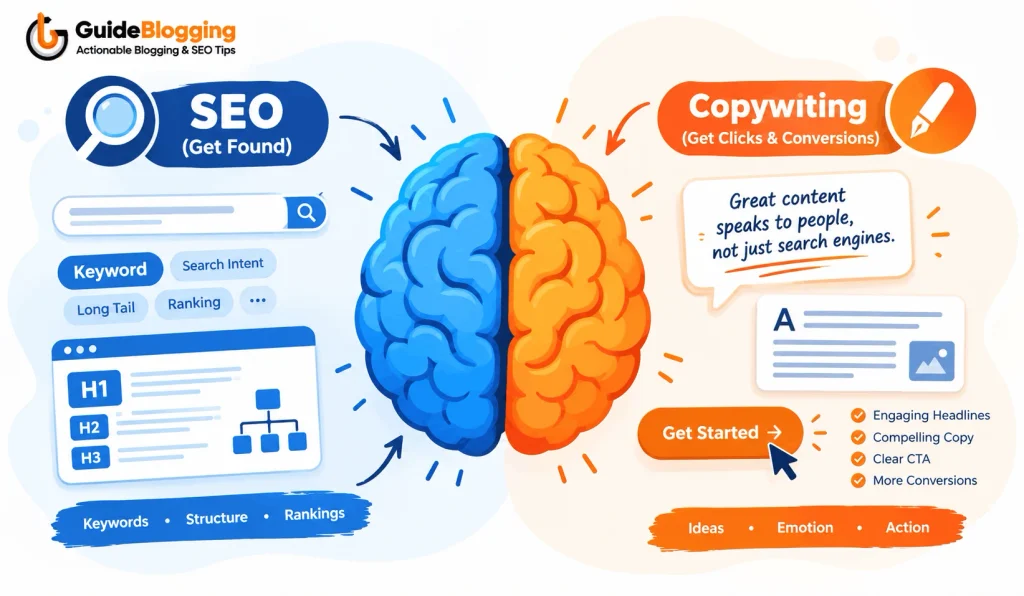
SEO copywriting is the practice of writing content that ranks well in search engines and persuades readers to take action. It balances on-page optimization signals (keywords, structure, headings, meta tags) with copywriting principles (clarity, emotional hooks, CTAs) so that the same piece of content performs in both the algorithm and the real world.
SEO copywriting has two halves that have to function simultaneously.
The SEO side handles keyword placement, content structure, heading hierarchy, meta tags, and URL optimization. These are the signals search engines use to understand what a page is about and decide whether it deserves to rank for a specific query.
The copywriting side handles persuasion, emotional hooks, benefit-led writing, and calls to action. These are the elements that make a human reader stay on the page, trust what they are reading, and take the action you want them to take.
You need both because each half fails without the other. On-page SEO without copywriting gets rankings but produces no conversions. Copywriting without SEO produces great content that nobody finds.
The 2026 reality adds a third layer. Google’s E-E-A-T framework, AI Overviews, and the rise of zero-click searches mean your SEO copy now needs to satisfy a search algorithm, pass featured snippet extraction criteria, inform an AI summary system, and hold a real human’s attention all at the same time.
The examples in this guide were selected because they succeed at all four.
In one sentence for clarity: SEO copywriting is writing that is structured for search engines to find and compelling enough for humans to act on.
Why SEO Copywriting Examples Matter More Than Rules
Most SEO copywriting Tips give you a list of rules. Rules are abstract. Knowing that you should “write for search intent” does not tell you what that actually looks like on a product page for running shoes or a homepage for a SaaS tool.
The gap between knowing a principle and being able to execute it closes the moment you see a real example taken apart and explained. That is exactly what this guide does for each of the 12 examples below.
Every example here comes from a brand that is actively ranking for competitive keywords, not from fabricated illustrations. The techniques behind each one are real techniques that produced real results.
One piece of data worth keeping in mind as you read: WordStream’s research shows that content over 3,000 words earns three times more traffic and three and a half times more backlinks than shorter content.
Depth is not optional in 2026 SEO copywriting.
But depth without structure is just a long page that nobody finishes. Every example below shows how depth and structure work together.
The 12 examples of seo copywriting are organized by content type so you can go directly to the format most relevant to what you are writing right now.
SEO Copywriting Examples by Content Type
SEO copywriting looks different depending on the content type you are working with.
A product description, a blog post title, a meta description, and a homepage headline all use the same underlying principles, but they apply those principles in different ways and in different locations on the page.
The examples below are grouped by type so you can see each principle working in context, not just in theory.
1. Product Description SEO Copywriting Example
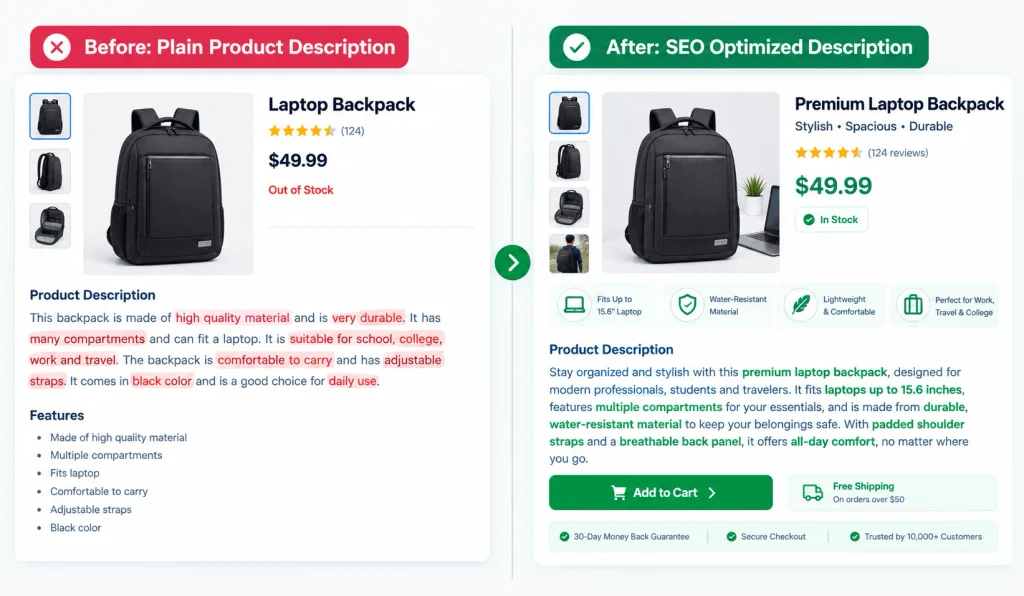
The unoptimized version:
“Our shoes are high quality and comfortable.”
The SEO-optimized version:
“Step into all-day comfort with our handcrafted leather shoes, designed to give you a perfect fit while lasting for years. Shop now and see why customers call them the most comfortable shoes they have ever owned.”
These two sentences describe the same product. One of them ranks. One of them converts. The difference is not the word count. It is every decision made inside those sentences.
Natural Keyword Integration Without Stuffing
The phrase “handcrafted leather shoes” appears once, naturally, in a sentence where it is the most logical way to describe the product. It does not repeat. It does not appear bolded or in a list. It reads exactly the way a confident brand description would read.
Benefit-Led Language Over Feature-Led Language
“High quality and comfortable” describes features. “All-day comfort” and “perfect fit” describe what the buyer experiences while wearing the shoes.
These are not the same thing. Benefits make the reader feel something. Features give the reader information. Feeling converts faster than information.
Social Proof Embedded in the Product Description
“Customers call them the most comfortable shoes they have ever owned” brings a third-party voice into the product description without requiring a separate testimonials section.
It is a trust signal built directly into the copy that makes the claim more credible than if the brand made it about itself.
Clear CTA Before the Reader Has Finished Reading
“Shop now” appears mid-sentence rather than at the end of a paragraph. By the time the reader finishes the sentence, they have already been invited to act. The invitation does not feel forced because it comes at the moment of highest engagement, right after the social proof lands.
The copywriting principle: Features tell, benefits sell. The unoptimized version describes what the shoe is. The optimized version describes how the reader will feel wearing it. Google rewards the latter because engaged readers stay on the page longer, and dwell time is a ranking signal.
2. Homepage Headline SEO Copywriting Example
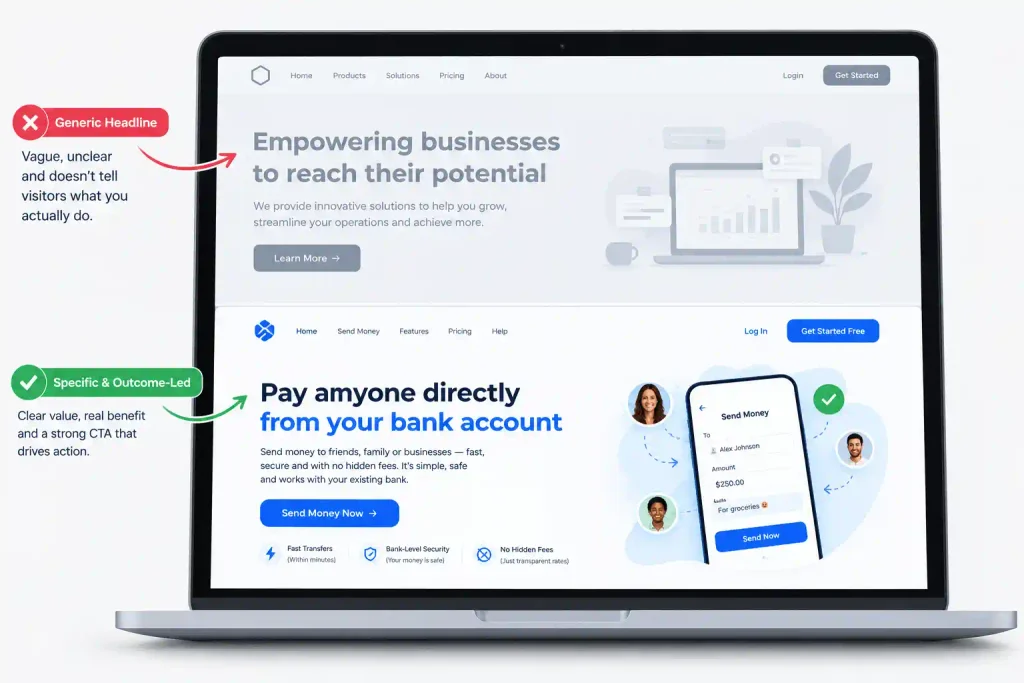
The example: “Pay anyone directly from your bank account.” (Inspired by leading fintech brands including Paytm)
Seven words. No jargon. No decorative language. Zero ambiguity about what the product does or who it is for.
Answers the Search Intent Instantly
A user arriving at a financial product homepage from a search query is asking one question: does this do what I came here for? This headline answers that question before the reader has had time to form a secondary thought.
Active Voice Eliminates Passive Reading Friction
“Pay anyone” is a command directed at the reader. It puts the reader in control of the action, which is exactly the psychological frame a payment platform wants to create. Passive alternatives like “Payments can be sent to anyone” remove the reader from the action and slow comprehension.
Completely Self-Explanatory With No Jargon
“Directly from your bank account” contains no technical terms, no product-specific language, and no assumption that the reader already knows what the company does. A person encountering this brand for the first time understands the proposition immediately.
Zero Ambiguity About What the Product Does
Generic positioning statements like “We are a team of passionate innovators dedicated to transforming the payments landscape” fail because they tell the reader nothing about what the product does for them. This headline contains a specific action, a specific scope, and a specific mechanism. That specificity is what makes it both SEO-friendly and conversion-ready.
The copywriting principle: The strongest homepage headlines answer one question above everything else. What does this do and who is it for? Specific, outcome-led headlines pass this test in their first sentence. Vague mission-statement headlines fail it before they finish their first clause.
3. Blog Post Title SEO Copywriting Example
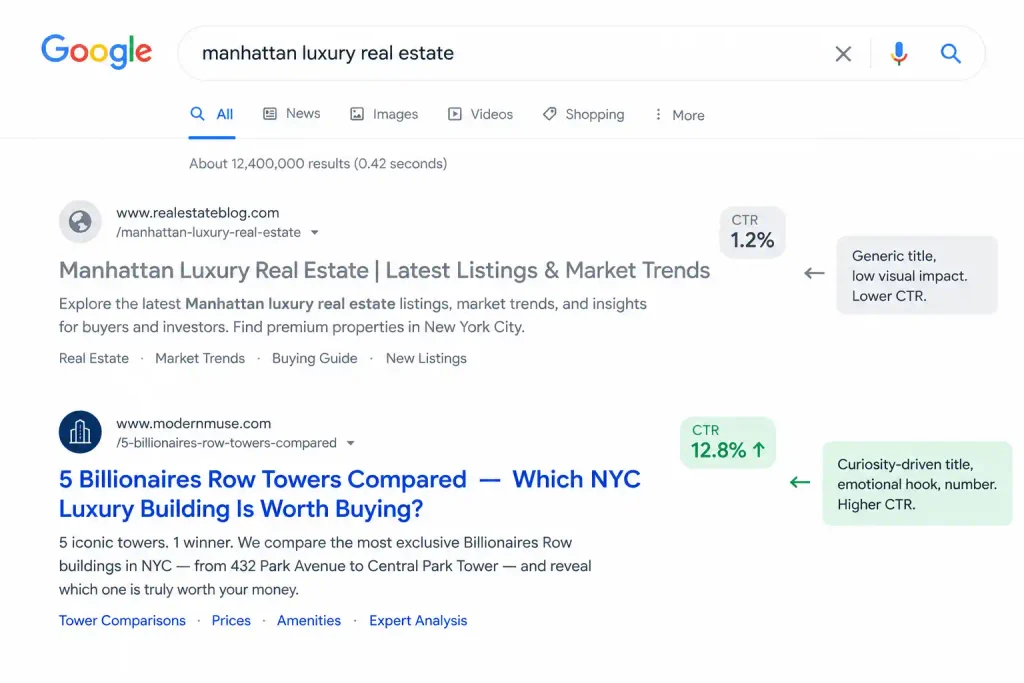
The example: Brian Dean’s documented CTR test where changing an article title from a straightforward functional description to an emotionally charged, curiosity-driven version lifted organic traffic by 45.52%.
The title that won was “Google Hates My Site.” The original was a factual description of the same content.
Emotional Triggers Mirror the Exact Language Real Users Use
Brian Dean found this phrase by browsing SEO forums where real users expressed their frustration in exactly those words.
He did not invent the emotional framing. He borrowed it from the people he was trying to reach.
When your title uses the exact words your audience uses to describe their problem, it bypasses the analytical part of the reader’s decision-making and speaks directly to the frustration they already feel.
The Title Matches the Pain Point, Not Just the Keyword
The keyword is about a technical topic. The title is about a human experience. Both appear in the same title because Brian Dean understood that the reader is not searching for a technical explanation.
They are searching for relief from a specific feeling. Writing to the feeling while targeting the keyword is the skill that separates high-CTR titles from low-CTR ones.
Numbers and Specificity Outperform Vague Descriptive Titles
Headline preference research shows that headlines with numbers are 36% more popular than those without. The specificity that a number creates tells the reader exactly what they are getting before they click.
This reduces uncertainty, and reduced uncertainty increases click-through rate.
The Curiosity Gap Technique
When a title raises a question the reader needs to answer or creates a tension they need to resolve, they click to resolve it. “Google Hates My Site” raises an immediate question: why? And what do I do about it?
The reader cannot know without clicking. That is the curiosity gap working exactly as it should.
The copywriting principle: Your title tag competes in a search results page the same way an advertisement competes in a social media feed. The title that wins the click is rarely the most technically complete description of the content. It is the one that hits an emotional nerve while staying accurate to what the reader will find after clicking.
Title optimization checklist:
- 50 to 60 characters maximum
- Primary keyword placed in the first half of the title
- At least one power word, number, or emotional trigger
- Message matches what is actually in the content
- No keyword repetition
4. Meta Description SEO Copywriting Example
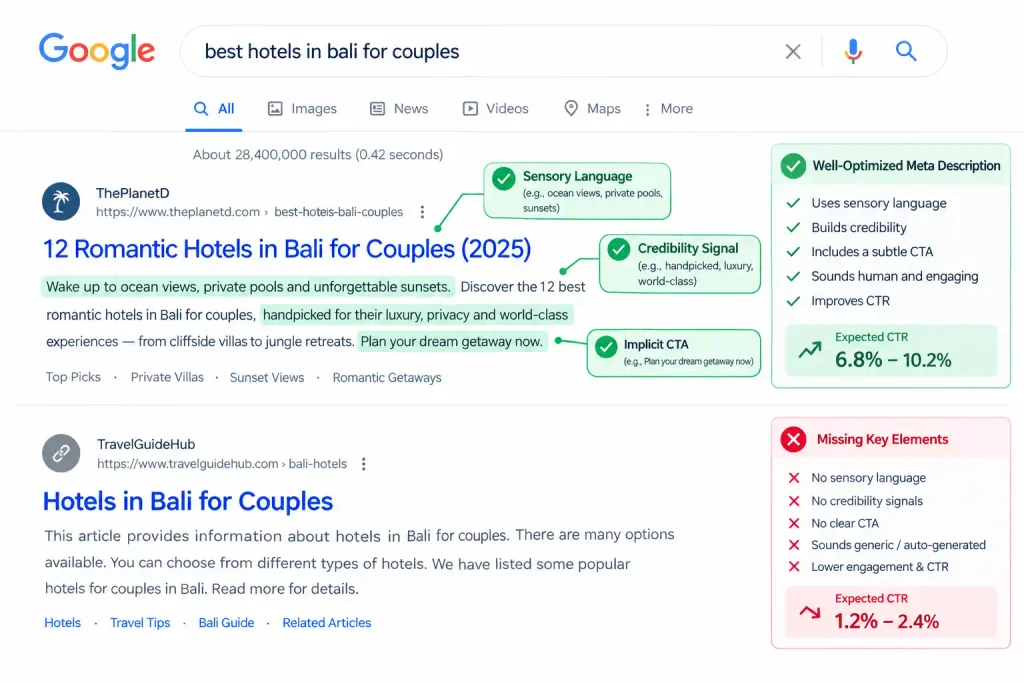
Good meta description example (search: “best burgers in London” ):
“Mouth-watering picks from food experts who have tested every burger joint in London. See which spots made the top 10 list.”
Bad meta description example (same search):
An auto-generated Huffington Post excerpt that leads with negative language, does not include the target keyword in bold, and fails to tell the reader why they should click this result instead of the others on the page.
Sensory Descriptive Language Triggers an Emotional Response
“Mouth-watering” is two words that do the work of an entire sentence. The reader has a physical response to that word before they have processed the rest of the description.
That physical response creates forward momentum toward the click. Generic descriptions like “This article covers the best burgers in London” create no momentum at all.
Credibility Signal Embedded Naturally
“Food experts who have tested every burger joint in London” tells the reader that the people behind this content have done the work the reader has not had time to do.
This is a trust signal delivered in eight words without a separate author bio, credential listing, or testimonial section.
It belongs in the meta description because it is the first place a skeptical reader looks when deciding whether a result is worth clicking.
Search Intent Alignment
A person searching “best burgers in London” is in commercial investigation mode. They are not looking for the history of London’s burger culture or a think-piece about artisan beef.
They want recommendations. The good meta description signals immediately that recommendations are what they will find. The bad one does not make that signal at all.
Implicit CTA Creates Forward Momentum
“See which spots made the top 10 list” is a CTA without the word “click.” It creates the feeling of an invitation rather than a command, and it specifies what the reader will get (a ranked list) without giving it away before they arrive.
The copywriting principle: Meta descriptions do not directly affect rankings, but they directly affect click-through rate, and click-through rate affects rankings. A well-written meta description is not a nice-to-have. It is the copy that determines whether your ranking translates into traffic.
Also Read: Blog Description 2026: Tips To Master A Perfect Description
5. Landing Page Headline SEO Copywriting Example
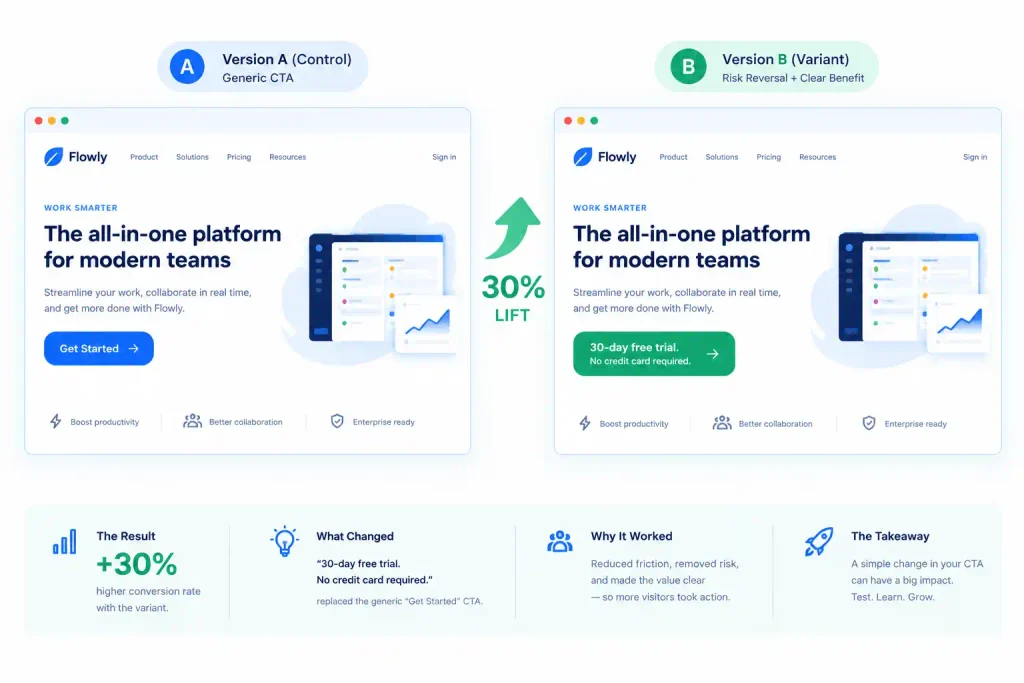
The example: The Highrise A/B test. Version B, which led with “30-day free trial. No credit card required,” outperformed the original version by 30% in conversions by addressing the reader’s primary objection before they had a chance to form it.
The Headline Removes Friction Before the Visitor Hesitates
The most common reason a user does not sign up for a free trial is the fear of being charged without meaning to, or the friction of entering payment details. “No credit card required” eliminates both fears in four words.
By the time the visitor has finished reading the headline, the objection that would have stopped them from converting has already been answered.
David Ogilvy’s Principle Applied Directly
Ogilvy documented that 80% of readers only ever read the headline. If the headline fails, the rest of the page is irrelevant to four out of five visitors. This A/B test confirms that principle with data. The winning headline did not have better body copy. It had a better headline.
The Guarantee Framing Uses the Benefit Without Drawback Formula
“30-day free” is the benefit. “No credit card required” removes the drawback. Together they form the most effective of the nine proven landing page headline formulas: tell the reader what they gain and simultaneously remove the thing they were afraid of losing.
Zero Jargon, Zero Decoration
The winning headline contains no product features, no brand voice flourishes, no industry terminology. It contains exactly one thing: the answer to the question the visitor was asking before they clicked.
The 9 proven landing page headline formulas:
- Product for target: “Project tracking for distributed teams”
- The fastest way to goal: “The fastest way to manage your invoices”
- Imperative benefit: “Send email that converts”
- Better purpose: “Better customer onboarding, without the complexity”
- Product that benefits: “Payroll software that saves you three hours every week”
- Benefit plus benefit: “More leads. Better conversions.”
- Benefit without drawback: “30-day free trial. No credit card required.”
- Question: “Ready to stop losing customers at checkout?”
- Purpose statement: “Bar inventory done in 15 minutes”
6. Introduction Paragraph SEO Copywriting Example
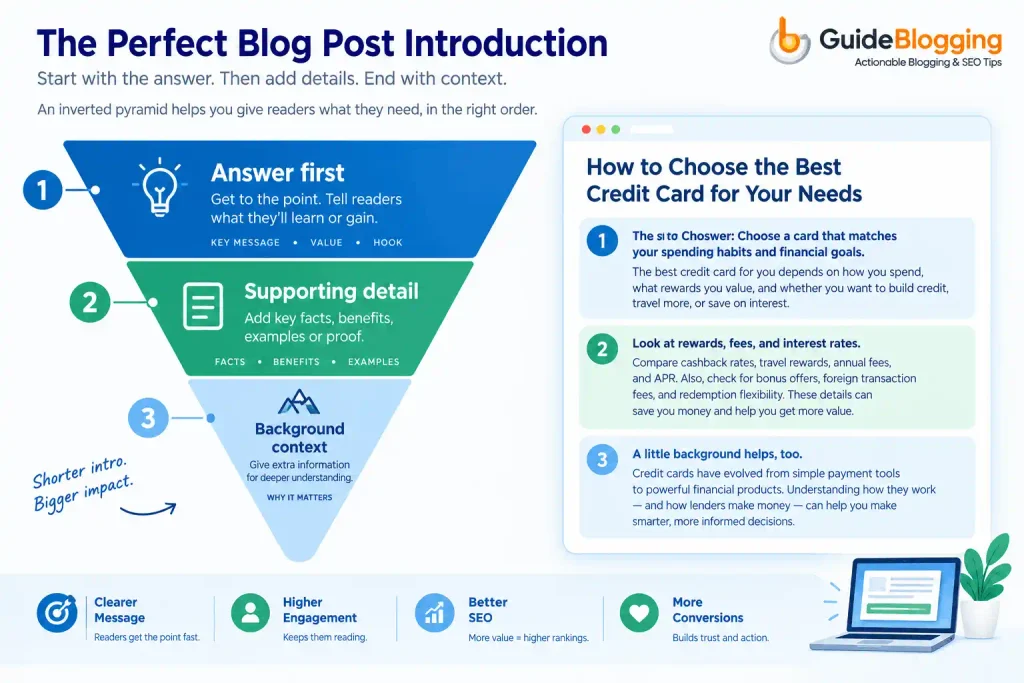
The example: Brian Dean’s APP method applied to a real blog post introduction.
The APP method is a three-part intro structure that makes the reader feel understood before making them a promise and then delivering a preview of what they are about to get.
- Agree: Open with a paragraph the reader will immediately agree with. Usually this is a statement about the problem they have or the frustration they are experiencing. It tells them you understand their situation before asking them to trust your solution.
- Promise: Follow with a statement about what is possible. Tell them what solving the problem actually looks like, with evidence if you have it.
- Preview: Close the intro with “In this guide, you will learn…” and list three to five specific things. This sets expectations and confirms to the reader that they are in the right place.
Inverted Pyramid Structure Serves Both Google and the Reader
The inverted pyramid means your most important information comes first and supporting detail comes after. AI Overviews and featured snippets extract from introductions and first paragraphs, not from conclusions. If your article’s core answer is buried in paragraph eight, neither the algorithm nor the human reader will find it before they leave.
The First Sentence Has One Job
The only job of your first sentence is to make the reader want to read the second sentence. Not to introduce yourself. Not to explain what the article is about. Not to provide background context. The first sentence exists to create enough forward momentum that the second sentence gets read.
NNGroup Eye-Tracking Research Confirms the Decision Window
NNGroup’s eye-tracking studies show that readers make their stay-or-leave decision within the first two paragraphs of a page. If the intro does not give them a reason to stay, they leave before they have seen 10% of your content.
The APP method structures the intro so that all three of the reader’s core needs (do you understand my problem, can you help me, is this worth my time) are answered before they get to the third paragraph.
AI Overviews Extract From Early, Direct Statements
Introductions that state their answer clearly in the first 50 to 100 words are significantly more likely to be cited in AI Overview responses than introductions that build slowly to the point. If you want your content to appear in AI-generated answers, the answer needs to be in the first section of your content, stated plainly.
Five opening sentence types that reliably hook readers:
- Curiosity: “You will never guess what the number one mistake in SEO copywriting actually is.”
- Question: “Did you know that 80% of readers only ever read the headline?”
- Empathy: “If you have been writing SEO content for months and still not seeing traffic, this is probably why.”
- Surprise: “Everything you have been told about keyword density in 2026 is outdated.”
- Statistic: “Changing a single blog post title lifted organic traffic by 45.52% in a documented test.”
Also Read: Tips for Blog Writing: The Ultimate Guide for Beginners & Experts
7. E-commerce Category Page SEO Copywriting Example
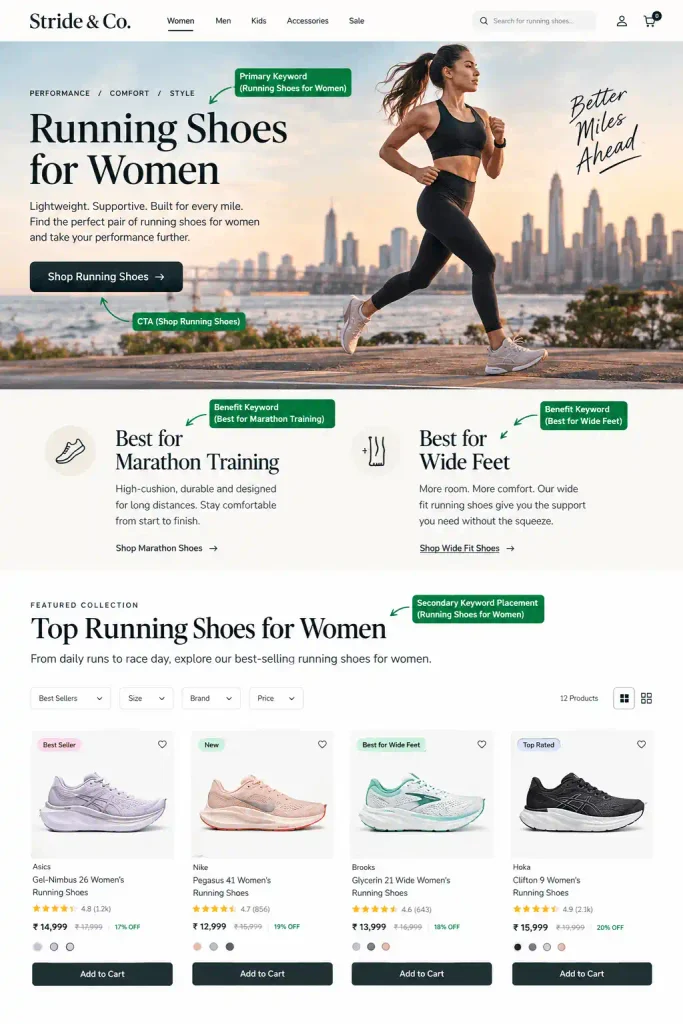
The example: A well-structured e-commerce category page for “running shoes for women” that places the primary keyword in the opening two sentences naturally, uses benefit-led subheadings as H3 section headers, embeds secondary keywords like “best lightweight running shoes” and “long-distance running shoes for women” in those subheadings, and places a CTA both above the product grid and again after it.
Category Pages Need to Rank AND Convert on the Same Page
Most e-commerce brands treat category page copy as a technical SEO task.
They add a paragraph at the top with the target keyword a few times and move on. The brands that convert significantly better treat the category page as a copywriting opportunity.
The copy at the top of the page is not there to satisfy an algorithm. It is there to confirm to the reader that they have arrived at the right place and to give them a reason to keep scrolling.
Keyword Placement in the First 100 Words
The primary keyword appears in the first two sentences of the category page intro. Not because a keyword density formula requires it, but because the first 100 words of a page are where Google’s crawlers place the highest weight on relevance signals.
Getting the keyword in early, naturally, is one of the lowest-effort, highest-impact moves in category page optimization.
Benefit-Led Subheadings Match Commercial Investigation Intent.
Subheadings like “Best for Marathon Training” and “Best for Wide Feet” match the specific search modifiers people use when they are in commercial investigation mode.
A person searching “running shoes for women wide feet” is not looking for a category overview. They are looking for confirmation that this page has what they need.
A subheading that speaks directly to that modifier tells them they are in the right place without requiring them to scroll through every product.
The copywriting principle: Category page copy is the most overlooked conversion opportunity in e-commerce SEO. Treating it as a copywriting task rather than a technical checkbox is what separates the brands that rank and convert from the ones that only rank.
8. Apple SEO Copywriting Example
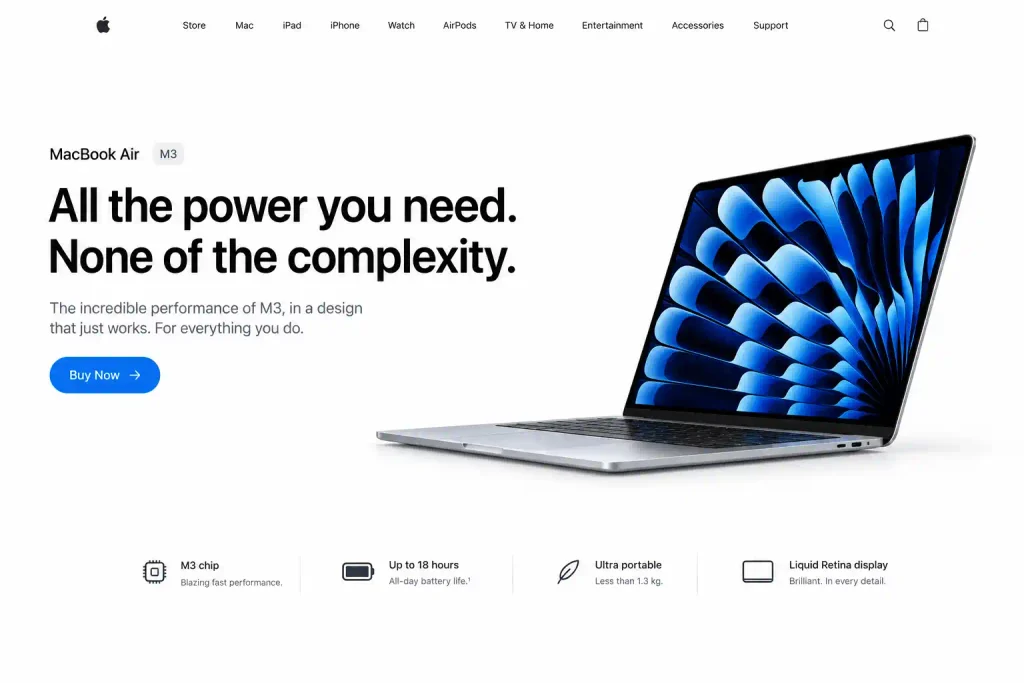
The example: Apple’s product pages for iPhone, which consistently open with a single benefit-led headline followed by one short supporting sentence, with one primary CTA and no competing options on the page.
Single Most Important Benefit in the Headline
Apple never lists three features in a headline. They identify the single most compelling thing about the current product version and state it once, cleanly. “The most powerful iPhone ever” or “Brilliant And brilliant for the environment.”
These headlines work because they do not try to say everything. They say the one thing that matters most to the reader who is already on the page.
Short Sentences Reduce Cognitive Load
Apple’s supporting sentences are typically one clause long a single subject, a single verb, a single idea. Short sentences are faster to process.
Faster processing means the reader spends less cognitive energy on the sentence and more attention on what the sentence is saying.
This is particularly important in product copy where the reader’s attention is split between the copy and the product image.
Consistent brand Voice Creates Trust Through Familiarity
Every Apple product page sounds like every other Apple product page. The tone, the sentence length, the headline structure, and the CTA language are consistent across every category.
Consistency is itself a trust signal. When a reader encounters the same voice and structure they have seen before, they have already decided they trust this brand before they have read a single word of the new page.
One Primary CTA With No Competing Options
Apple product pages do not have five different CTAs competing for attention. They have one primary action the reader should take at any given point in the page, and that is the only CTA visible until the reader has scrolled past the primary content.
Reducing decision paralysis is a conversion optimization principle. Apple applies it with more discipline than almost any other brand in the world.
The copywriting principle: Simplicity is a copywriting choice, not a limitation imposed by minimalist design. The discipline to say one thing exceptionally well rather than five things adequately is the decision that separates Apple’s copy from most brand websites and from most SEO content you will read today.
9. Nike SEO Copywriting Example
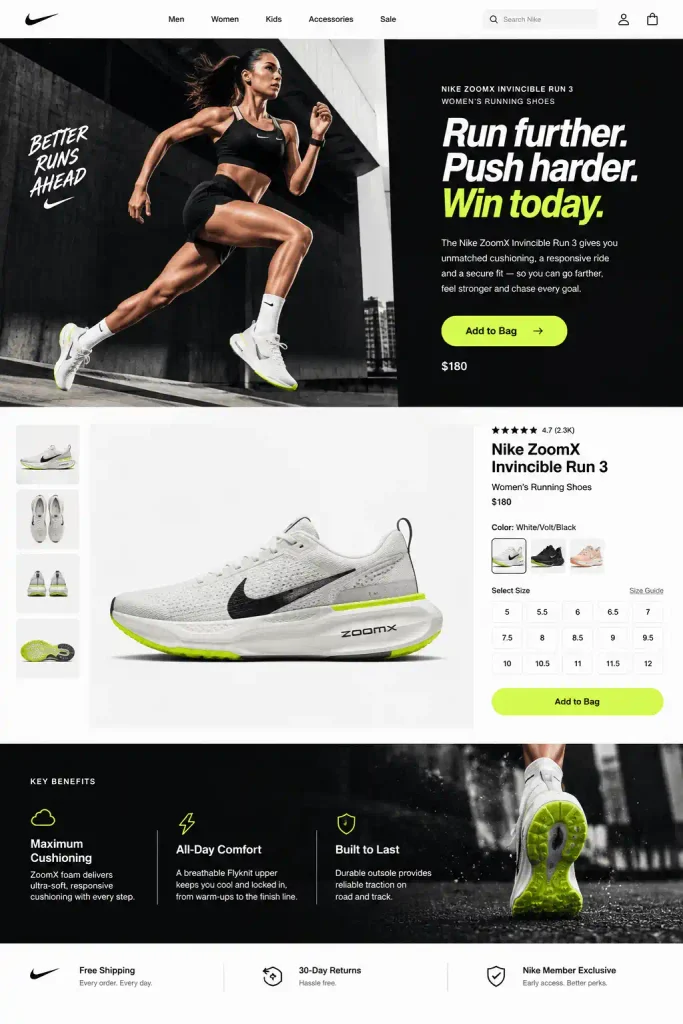
The example: Nike’s product descriptions and campaign copy, which consistently use the second-person active voice, aspiration-led language, and active verbs at the start of sentences.
Second-Person Writing Makes Copy Feel Personally Addressed
Nike’s copy does not talk about the customer. It talks to the customer. “You need a shoe that keeps up” positions the reader as the active participant in the copy rather than a passive observer of a product description.
When copy feels personally addressed, readers engage with it the way they engage with direct conversation rather than the way they scroll past a broadcast announcement.
Active Verbs Create Momentum in the Reader
“Run further. Push harder. Win today.” Three sentences. Three active verbs at the start of each. The rhythm creates forward momentum that pulls the reader through the copy the same way a strong opening line pulls them to the second sentence.
Nike’s copy almost never uses passive constructions. The reader is always doing something in Nike’s world.
Aspirational Framing Works as a Search-Indexed brand Statement
“Just Do It” is not just a tagline. It is a brand statement that has accumulated enough indexed associations across millions of web pages that it functions as a keyword cluster in its own right.
When people search for motivation-related running content, Nike’s copy surfaces because the copy is built around the emotional territory of aspiration rather than the functional territory of product specifications.
Product Descriptions Focus on What the Product Enables
Nike’s product descriptions rarely lead with materials or construction. They lead with performance: “Designed for long-distance comfort” rather than “Features a foam midsole.” The foam midsole produces the long-distance comfort. But the reader does not want the material. They want the outcome.
The copywriting principle: The emotion that motivates a purchase is almost never the feature. It is the version of themselves the buyer imagines while using the product. SEO copy that writes toward that aspiration converts at a higher rate than copy that describes what the product is made of.
10. PayPal SEO Copywriting Example
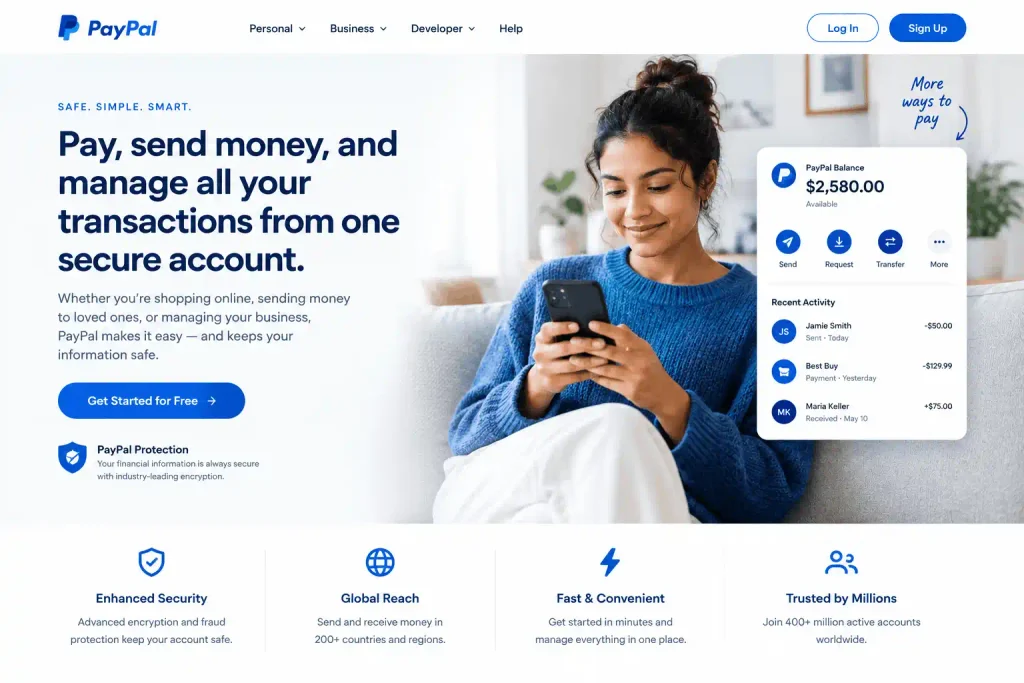
The example: PayPal’s homepage copy: “Pay, send money, and manage all your transactions from one secure account.”
This is 13 words that answer three questions a financial product user has before they trust any platform: what can I do with this, can I do more than one thing, and is it safe?
Three Specific Benefits in One Sentence
Pay. Send money. Manage transactions. Three distinct actions. Three distinct user needs one sentence. There is no preamble, no brand positioning language, no statement about PayPal’s mission or values. The copy starts with what the user can do and ends without decorating it with anything that is not useful.
Addressing the Primary Objection in the Same Sentence as the Benefit
“One secure account” does not follow the benefits with a separate trust section. It embeds the trust signal in the same breath as the proposition.
A user who was about to feel nervous about entering their financial information has already been reassured before they have finished reading the headline.
Financial Product Search Intent Is Almost Always Commercial Investigation
When someone lands on PayPal’s homepage from a search, they are asking: does this do what I think it does and can I trust it with my money?
PayPal’s headline answers both questions in the first sentence. Most financial product homepages require a paragraph or two before they get to the answer. PayPal gets there in 13 words.
Secondary Keyword Embedded Naturally
“Send money” appears naturally in a sentence where it is the clearest description of what a user wants to do. It is not placed there because a keyword tool identified it as a secondary search term, even though it is.
It is placed there because it is the most accurate word for the action. That is natural keyword integration.
The copywriting principle: Clarity converts. The clearest explanation of what a product does and why it is safe to use will always outperform clever brand language in search-driven copy.
PayPal’s homepage is proof that you do not need creative copywriting to write effective SEO copy. You need honest, specific, benefit-led copy.
11. ChatGPT Landing Page SEO Copywriting Example
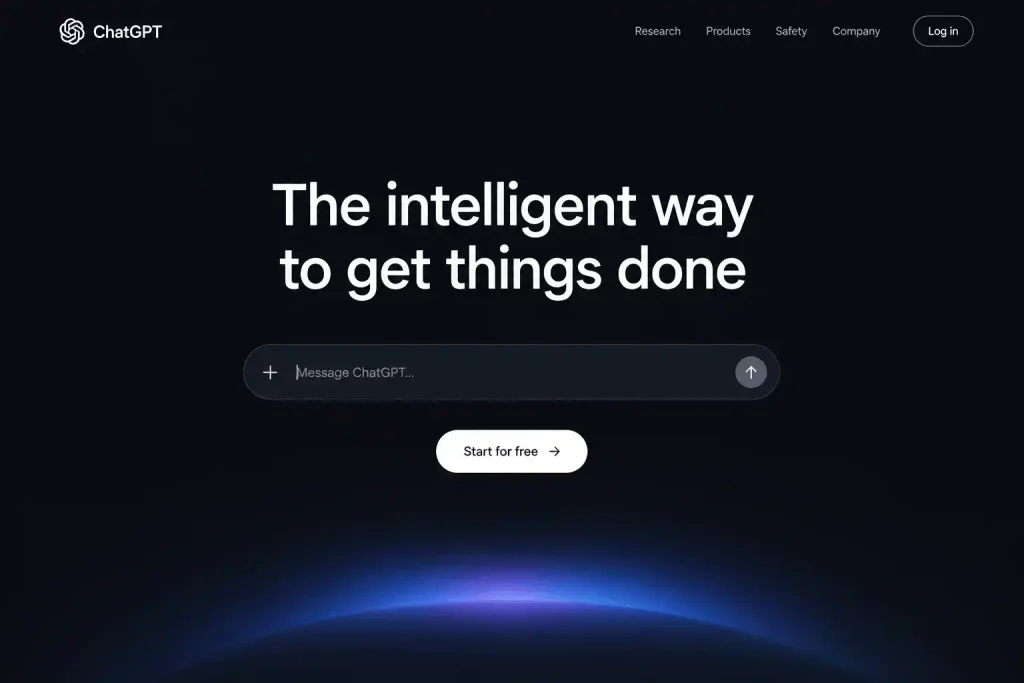
The example: ChatGPT’s landing page headline: “The intelligent way to get things done.”
This headline is for one of the most technically sophisticated products ever built, and it does not mention a single technical feature. That is not an oversight. It is the most precise decision on the page.
The Superlative Frames the Product Without Requiring Proof
“The intelligent way” positions ChatGPT as a superior approach without making a comparative claim that requires data to support. It is not “the most intelligent AI” or “smarter than every competitor.” It is simply “the intelligent way,” which implies that alternatives are less intelligent without saying so explicitly.
“Get Things Done” Maps to the Broadest Possible Commercial Intent
Productivity is one of the broadest search intent categories that exists. People who want to work faster, write faster, research faster, and think through problems faster all fit inside the phrase “get things done.” By choosing the broadest possible outcome statement, ChatGPT’s copy captures the widest possible audience without being vague about the core proposition.
No Jargon Despite Being a Technical AI Product
The product involves large language models, transformer architecture, and neural networks. The headline contains none of those terms. The audience for this headline is not AI researchers.
It is people who want to be more productive. The copy speaks to that audience rather than to the people who built the product.
Simplicity Is a Trust Signal
When a product is truly confident in what it does, the copy does not need to oversell it. The brevity of the ChatGPT headline signals confidence.
A landing page that requires 200 words to explain the proposition signals doubt. The reader picks up on both signals even when they are not consciously analyzing the copy.
The copywriting principle: In a crowded market where every brand is shouting features and benefits, a headline that states a clear purpose and confidently stands out precisely because of its restraint. This is the “product that benefit” formula applied with more discipline than most landing pages manage.
12. Blog Post Conclusion SEO Copywriting Example
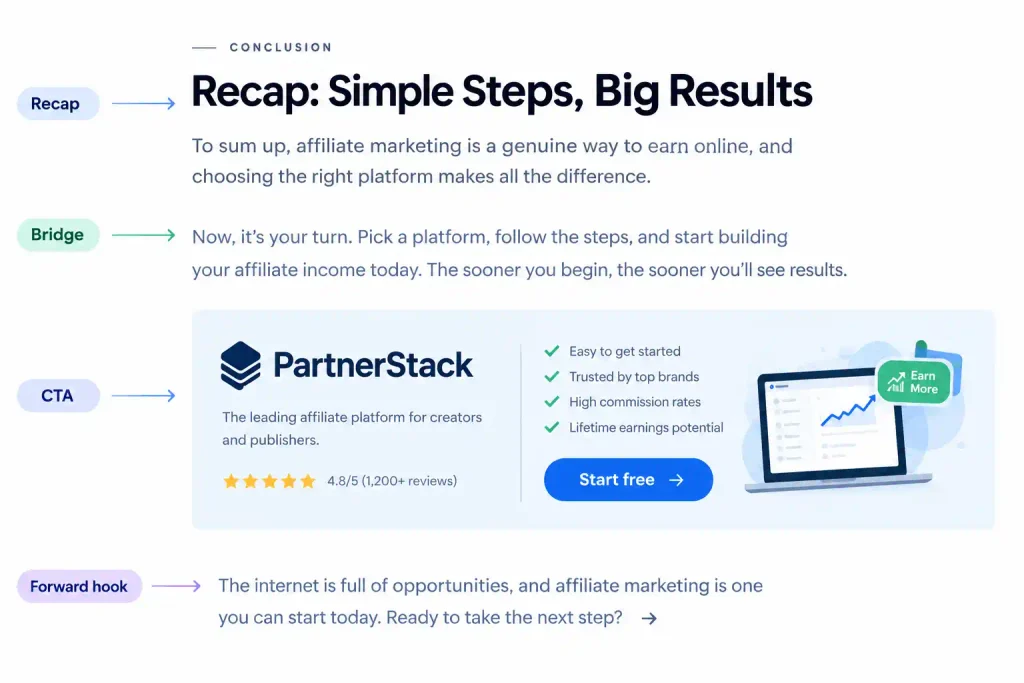
The example: A well-structured blog post conclusion that recaps the core insight in one sentence, uses a transition phrase that bridges naturally to the CTA, includes one specific affiliate recommendation tied to the article topic, and closes with a forward-looking statement.
Most Blog Conclusions Are Afterthoughts
The average blog post conclusion is a paragraph that begins with “In conclusion” and summarizes every heading the reader just finished reading. This adds no value for the reader and actively reduces engagement time right before the conversion moment. The reader who just read 3,000 words does not need a summary. They need a next step.
A CTA Placed After Genuine Value Delivery Converts Higher
The documented A/B test data is clear: a CTA versus no CTA in content boosted clicks by 2,666% in one test. But the placement of that CTA matters as much as its presence.
A CTA that appears before the reader has been given a reason to trust your recommendation converts at a fraction of the rate of a CTA that arrives after the reader has been given 3,000 words of genuine value.
The conclusion is the highest-trust moment in any long-form article. That is when the reader is most likely to act.
Google’s Engagement Signals Peak at Scroll Depth
Time on page and scroll depth are engagement signals that Google uses to evaluate content quality. A conclusion that delivers a satisfying ending produces better scroll depth than a conclusion that trails off.
A reader who reaches a strong conclusion has demonstrated the highest level of engagement available on a single page.
The copywriting principle: Your conclusion is your closing argument. The reader who has stayed with you for 3,000 words has already decided they trust your judgment. Treating the conclusion as a formality wastes the highest-trust moment in the entire piece. Treat it like a recommendation from a friend rather than a footnote from an editor.
SEO Copywriting Best Practices That Connect All 12 Examples
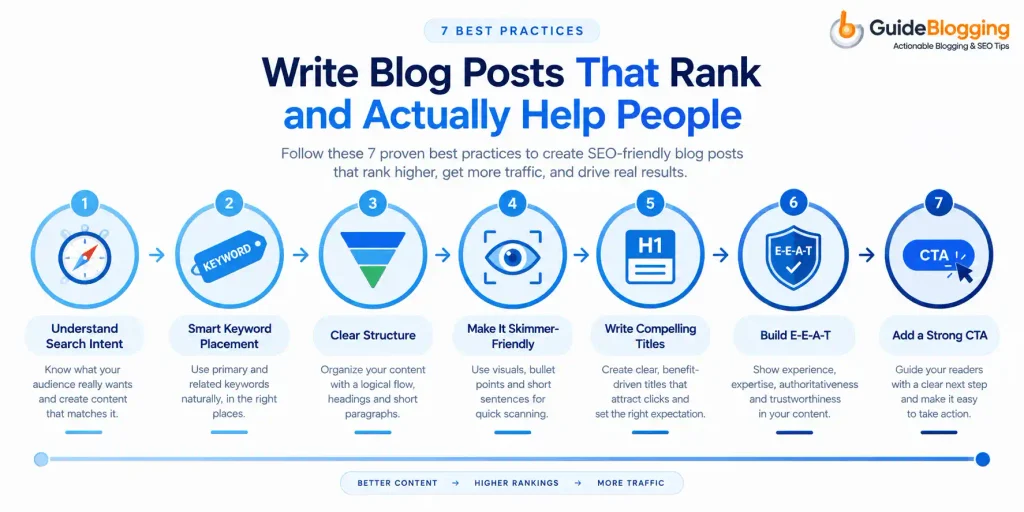
Every example above works because it applies one or more of the following practices consistently. These are not abstract principles that live in a guide you read once and forget. Each one is visible in the examples above if you know what to look for.
1. Match Search Intent Before You Write a Single Word
There are four types of search intent: informational (the user wants to learn something), navigational (the user wants to find a specific page), commercial investigation (the user is researching before a purchase), and transactional (the user is ready to buy right now).
Matching your content format to the intent behind your target keyword is the single most important decision in SEO copywriting. Writing a product page for an informational keyword wastes the ranking opportunity because Google will not rank a commercial page for a query that is asking a question.
Writing an article for a transactional keyword misses the conversion opportunity because the reader came ready to act and you are asking them to read first.
The fastest way to identify intent accurately is to look at the top three ranking pages for your target keyword and note the format they use.
If all three are listicles, write a listicle. If all three are comparison guides, write a comparison guide. If yours is the only page in the results that looks different from the others, you have probably misread the intent.
2. Place Keywords Where They Signal Relevance, Not Where They Interrupt Flow
The six locations where keyword placement has the highest SEO signal value are the page title, the URL, the meta title tag, the meta description, the introduction paragraph, and H2 and H3 subheadings.
After those, keywords in the body copy carry signal value proportional to how naturally they appear.
Natural keyword density is not about a percentage. It is about whether a keyword appears because it is genuinely the clearest way to say what you mean.
If you find yourself restructuring a sentence to fit a keyword in, the keyword placement is probably doing more harm to the copy than good for the ranking.
Secondary keywords are where significant organic traffic gets left on the table.
Ahrefs research shows that the number one ranking page for a given query also ranks for an average of 1,000 related terms. Secondary and LSI keywords in your subheadings and body copy are the mechanism that creates that expanded footprint.
3. Lead With the Answer Using the Inverted Pyramid Structure
The inverted pyramid is a journalism principle applied to SEO copy. Most important information first. Supporting detail second. Background context last.
This matters for SEO because AI Overviews and featured snippets extract from introductions and first paragraphs. If your core answer is in paragraph six of eight, the AI system will not find it, and the featured snippet will go to the page that put its answer in paragraph one.
This matters for readers for the reason the NNGroup eye-tracking research documented. The stay-or-leave decision happens within the first two paragraphs.
A reader who has not been given a reason to stay by paragraph two will not reach paragraph six regardless of how good the content is.
The APP method is the most practical framework for writing intros that apply the inverted pyramid correctly.
Agree with the reader’s problem, make a specific promise about what they will get, and preview the content clearly enough that they know they are in the right place.
4. Write for Skimmers Without Losing Depth
Only 16% of people read every word on a web page. That number is not a reason to write shorter content. It is a reason to structure your content so that the 84% who skim still get enough value to stay engaged and the 16% who read everything find the depth they came for.
Skimmable SEO copy has short paragraphs (two to three sentences maximum), informative subheadings that communicate meaning even when the body text is skipped, bullet points for information that is genuinely list-like, and one idea per sentence rather than multiple clauses per sentence.
The visual cue toolkit for stopping skimmers includes quote boxes that use color contrast to interrupt the scan, pull quotes that surface the most important insight from a section without requiring the reader to read the whole section, action boxes that make the takeaway immediately visible, and numbered lists that create an automatic scan pattern.
Skimmability and depth are not in conflict. Short paragraphs can contain dense, high-value information. The format serves the reader. The content serves their knowledge needs. Both can be present in the same article.
Also Read: 20 Off-Page SEO Tactics That Actually Work in 2026 (Complete Guide)
5. Optimize Your Title Tag and Meta Description as Standalone Copy
Most bloggers spend hours writing the body of an article and 45 seconds writing the title. This is the wrong ratio. The title determines whether anyone reads the body at all.
- Title tag checklist: 50 to 60 characters, primary keyword placed in the first half, at least one power word or number, accurate message match to the content, no keyword repetition in the same title.
- Meta description formula: lead with the search intent your content serves, include one specific data point or detail that demonstrates the depth of the content, end with an implicit CTA that creates forward momentum, stay under 160 characters.
Brian Dean’s documented title test showed a 45.52% organic traffic lift from changing a single title.
The meta description and title tag are the only two pieces of copy that every reader of a given SERP sees before they visit any page. Treating them as an afterthought is treating your highest-traffic copy with the least care.
6. Optimize for E-E-A-T in Every Piece You Publish
E-E-A-T stands for Experience, Expertise, Authoritativeness, and Trustworthiness. Google’s quality rater guidelines use these criteria to evaluate content, particularly in YMYL categories (Your Money or Your Life) that cover finance, health, and safety topics.
For copywriters, E-E-A-T translates into specific writing decisions: use first-person experience when you have it, name the author and their credentials in every piece, cite data sources rather than making claims without attribution, and use specific examples rather than generic statements that could apply to anything.
In 2026, E-E-A-T signals carry more weight than in any previous year. With 75% of content marketers using AI for content production, the web is being flooded with copy that is technically correct but experientially empty.
The copy that differentiates itself contains what AI cannot generate: original research, documented personal experience, real test results, and opinions based on actual practice rather than synthesized training data.
7. Always Include a Clear CTA Before the Reader Leaves
The documented data from CTA testing is not ambiguous. A CTA versus no CTA in the same piece of content boosted clicks by 2,666% in one controlled test.
If you are not including a CTA, you are not giving the reader permission to act, and readers who are not permitted to act rarely take the initiative to find the action themselves.
CTA placement strategy by content type follows a simple rule: blog posts need CTAs in the introduction (for readers who already trust you), in the middle of the content (for readers who are engaged but have not committed), and in the conclusion (for readers who have read everything and are most ready to act).
Landing pages need a CTA above the fold and again directly after the primary benefit statement. Product descriptions need a CTA in the last sentence of the copy.
CTA language specificity is the difference between a CTA that gets clicked and one that gets ignored. “Start your free 14-day trial” is specific. “Click here” is not.
The specific CTA tells the reader exactly what happens when they act. The vague one asks for trust without providing a reason to extend it.
SEO Copywriting in 2026: What Has Changed
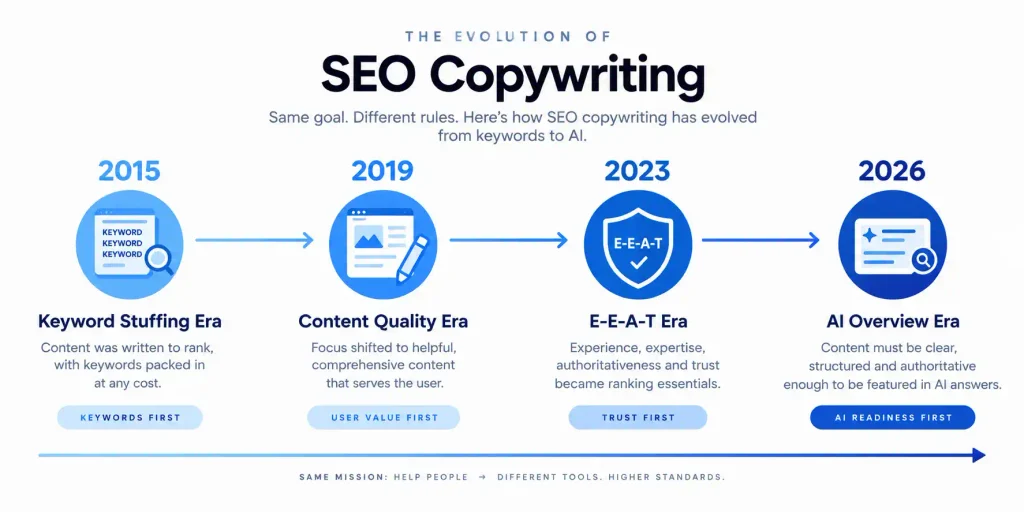
Nearly 60% of Google searches in 2024 resulted in zero clicks. Writing copy purely for traditional organic rankings is no longer enough.
You need to appear in AI Overviews, traditional organic results, and featured snippets simultaneously to capture the full available attention for any given query.
- Writing for AI Overviews requires a specific structural approach. Include a concise answer block near the top of your content that states the answer to the primary question directly. Use structured subheadings that make each section’s topic clear to a machine extracting content. Cover the question fully in the content itself without requiring the reader to click elsewhere for a complete answer.
- The E-E-A-T intensification is the most significant change for content writers in 2026. Google’s quality rater guidelines now place more explicit weight on E-E-A-T signals than in any previous year, and the reason is the proliferation of AI-generated content that is technically correct but lacks the experience and expertise signals that distinguish genuinely authoritative content from sophisticated synthesis.
- AI-generated content creates a differentiation opportunity for writers who provide what AI cannot. Original survey data. Documented personal results. Real A/B test outcomes. Specific case study details. Named sources with credentials. The more AI-generated content floods the web, the more valuable human-generated experience becomes as a ranking signal.
- Featured snippets carry a 42.9% click-through rate. Despite zero-click trends, featured snippets still drive significant traffic because they appear above the organic results and often above the AI Overview. Structuring one clear, direct answer per major question in your content is the most reliable path to featured snippet eligibility. That means a direct answer in one to two sentences, followed by supporting detail, for every significant question your content addresses.
Best Tools for Writing and Optimizing SEO Copy in 2026
Knowing the principles behind good SEO copywriting is step one. Having the right tools to apply those principles faster, check your work before publishing, and track what is actually performing after publishing is what separates consistent results from occasional good copy.
| Tool | Best For | Free Option | Starting Price |
|---|---|---|---|
| Semrush | Keyword research, SEO Writing Assistant, competitor copy analysis | Limited free account | $117.33/mo (annual) |
| Ahrefs | Secondary keyword discovery, content gaps, backlink analysis | Ahrefs Webmaster Tools | $129/mo |
| Yoast SEO | On-page keyword placement, meta tag optimization, readability | Free WordPress plugin | Free (premium $99/year) |
| Surfer SEO | Real-time content optimization against top-ranking competitors | No | $79/mo |
| Hemingway App | Readability scoring, sentence length, passive voice detection | Free browser version | Free |
| Google Search Console | Performance tracking, keyword data, featured snippet monitoring | Free | Free |
Semrush’s SEO Writing Assistant is worth singling out because it is the only tool on this list that applies multiple SEO copywriting best practices simultaneously in real time.
As you write, it scores your keyword usage, readability, tone consistency, and originality in a live sidebar. For anyone who finds themselves second-guessing keyword placement or readability decisions mid-draft, it replaces the guesswork with actual data.
FAQs About SEO Copywriting
What is SEO copywriting?
SEO copywriting is the practice of writing content that ranks in search engines and persuades readers to take action. It combines keyword research and on-page optimization with copywriting principles like benefit-led writing, emotional hooks, and clear calls to action.
What is a good example of SEO copywriting?
A good SEO copywriting example matches search intent exactly, leads with the answer the reader came for, places keywords naturally in the title, first paragraph, and subheadings, and ends with a clear CTA. Apple’s product pages, PayPal’s homepage, and Nike’s product descriptions are all studied examples of these principles working in practice at scale.
What are the most important SEO copywriting best practices?
The seven most important are: match search intent before writing, place keywords naturally where they signal relevance, lead with the answer using the inverted pyramid structure, write for skimmers without losing depth, optimize title tags and meta descriptions as standalone copy, build E-E-A-T signals throughout every piece, and include a clear CTA before the reader leaves.
How is SEO copywriting different from regular copywriting?
Regular copywriting focuses purely on persuasion and conversion. SEO copywriting adds a second layer: the content must also be structured and written in a way that search engines can find, understand, and rank for specific keyword queries. Both require compelling writing. Only SEO copywriting also requires intentional keyword placement, heading structure, and meta tag optimization.
Does SEO copywriting still matter in 2026?
Yes. Organic search drives over 53% of all website traffic, and SEO leads have a 14.6% close rate. While AI Overviews and zero-click searches have changed how copy needs to be structured, the fundamental skill of writing content that ranks and converts has become more valuable in 2026, not less, as AI-generated content floods the web and differentiated, experience-based copy becomes increasingly rare.
What tools do professional SEO copywriters use?
The most widely used tools are Semrush (keyword research and SEO Writing Assistant), Ahrefs (secondary keyword discovery and competitor content analysis), Yoast SEO (on-page optimization and readability scoring), and Google Search Console (performance tracking and keyword click data).
How long should SEO copy be?
It depends on the search intent behind your target keyword. Ahrefs data shows pages above 3,000 words earn three times more backlinks than shorter content. But commercial and transactional pages should be as long as they need to be to answer every objection and no longer. Match the length of the top three ranking pages for your target keyword as your starting benchmark and adjust based on what the content actually requires.
What is the inverted pyramid in SEO copywriting?
The inverted pyramid means leading with your most important information first and adding supporting detail and background context afterward. In SEO copywriting, this structure matters because AI Overviews and featured snippets extract from introductions and first paragraphs. If your core answer is in paragraph six, neither the algorithm nor the human reader will find it before they leave.
Final Thought
SEO copywriting is not a single skill. It is a set of decisions about keyword placement, structure, headline framing, and CTA design that you make every time you write a page, a product description, a blog post title, or a meta description.
The brands producing the most traffic and conversions from search in 2026 are not the ones who know the most rules. They are the ones who have seen enough good examples to recognize the decisions behind them and have the tools to execute those decisions consistently across everything they publish.
ASLO READ: