
Quick Answer: You can find LSI keywords using free Google features (Autocomplete, People Also Ask, Related Searches, bolded snippet words), dedicated LSI keyword generator tools (LSI Graph, Answer Socrates), and paid SEO platforms (Semrush, Ahrefs, Surfer SEO). LSI keywords are words and phrases semantically related to your main topic that help search engines understand the full context of your content.
If you have ever wondered why some articles rank for dozens of related keywords while yours only ranks for the exact phrase you targeted, the answer is almost always semantic coverage.
Finding LSI keywords is the practical tool for fixing that gap, and it costs nothing if you know where to look.
There is an honest debate worth addressing upfront: some SEO professionals argue that LSI keywords are outdated terminology and that Google does not technically use Latent Semantic Indexing anymore.
That debate is real. But the underlying practice, using semantically related words and phrases to help search engines understand your content fully, absolutely still matters and produces measurable ranking improvements.
This guide covers what LSI keywords actually are, whether Google still uses them, how to find them for free and with paid tools, and the best practices for using them in content that ranks.
What Are LSI Keywords?
LSI keywords, short for Latent Semantic Indexing keywords, are words and phrases that are semantically related to your main topic and commonly appear alongside it across the web.
They help search engines understand the broader context of your content beyond the exact keyword phrase you are targeting.
A straightforward example makes this clear. If your main keyword is “coffee,” LSI keywords might include “espresso,” “brewing,” “caffeine,” “roast,” “barista,” and “French press.”
A page that mentions all of these naturally signals to search engines that it is comprehensively about coffee as a topic, not just a page that repeats the word “coffee” as many times as possible.
One important distinction worth getting clear early: LSI keywords are not the same as synonyms. Synonyms replace your keyword.
LSI keywords expand the semantic field around it. “Car” and “automobile” are synonyms because they mean the same thing. “Car,” “engine,” “fuel efficiency,” “horsepower,” and “dealership” are LSI keywords for the topic of cars because they are related concepts that appear in the same semantic territory, not replacements for the main word.
What Is Latent Semantic Indexing (LSI)?
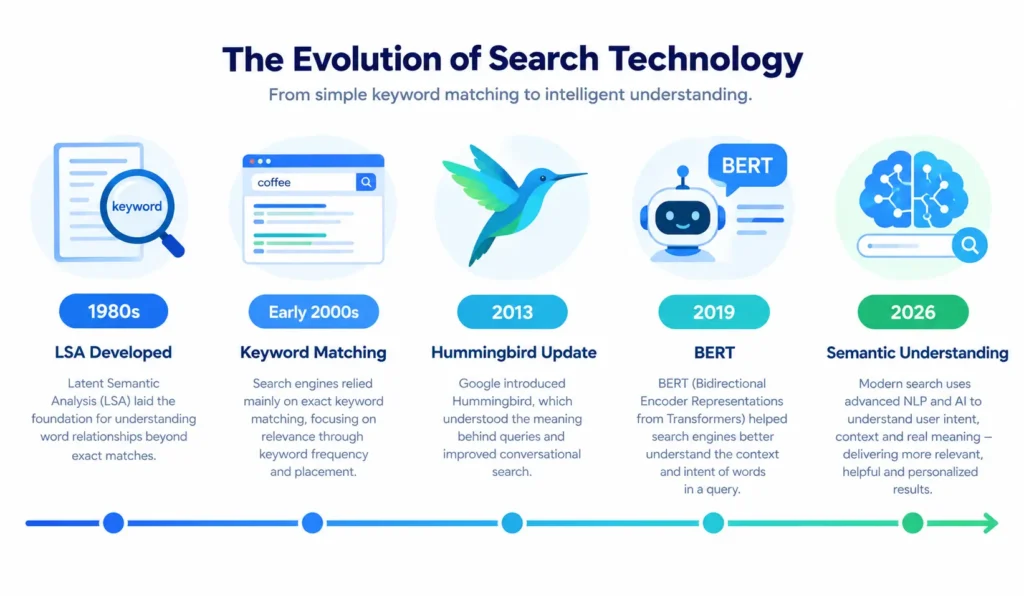
Latent Semantic Analysis (LSA) is a mathematical technique developed in the 1980s and 1990s that analyzes relationships between words in large text corpora to understand which terms frequently appear together and therefore likely relate to the same concept.
When early search engines applied this technique to web pages, it helped them understand documents beyond exact keyword matching.
A page about “automobile repair” could be identified as relevant to searches for “car maintenance” because the technique recognized that these topics shared the same semantic territory.
Latent Semantic Analysis is the broader linguistic theory that LSI is built on. The core insight is that meaning, called semantics, can be derived from patterns of word co-occurrence in text.
Words that consistently appear near each other across millions of documents are semantically related regardless of whether they are synonyms or even grammatically connected.
Does Google Actually Use LSI Keywords?
This question deserves a direct and honest answer rather than the vague treatment most SEO guides give it.
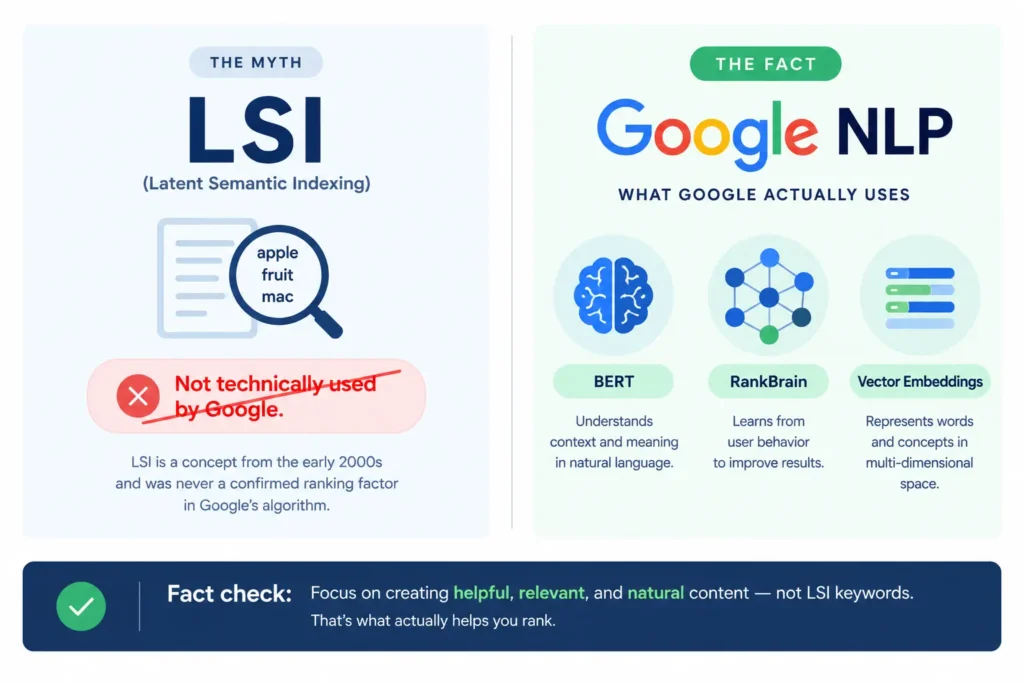
Google has explicitly stated it does not use LSI as a specific algorithm component. Google engineers have confirmed this in public statements.
The term “LSI keywords” as used in the SEO industry is technically a misnomer when applied to how modern Google actually processes content.
What Google uses instead is significantly more sophisticated:
1. Vector Embeddings
Google represents words and concepts as mathematical vectors, which are essentially points in a high-dimensional space where related concepts cluster close together.
This allows Google to understand relationships between meanings at a much deeper level than the co-occurrence patterns that traditional LSI relied on.
2. Knowledge Graph
Google’s Knowledge Graph is an entity-based understanding of real-world concepts and their relationships. Google does not just understand that “Paris” and “Eiffel Tower” appear together frequently.
It understands that the Eiffel Tower is a specific physical structure located in Paris, France, that is a tourist attraction, that it was built in 1889, and that it is connected to hundreds of other entities.
This is semantic understanding, not keyword co-occurrence matching.
3. Natural Language Processing Models
RankBrain, BERT, MUM, and Neural Matching are the NLP models that allow Google to understand the intent and context behind a search query and a piece of content simultaneously.
BERT in particular transformed Google’s ability to understand the meaning of a sentence as a whole unit rather than as a collection of individual words.
Why does the term “LSI keywords” still matter practically, despite being technically inaccurate?
Because even though the specific mechanism is not classical LSI, the practice of identifying and using semantically related terms still produces better rankings.
The underlying goal has not changed: comprehensive topical coverage using the language your audience and search engines associate with your topic.
The most useful framing for content creators is this: stop worrying about whether it is technically LSI and focus on the practical outcome.
Using related semantic terms naturally in your content helps Google understand your topic more completely, which improves rankings for both your target keyword and dozens of related queries.
Also read: Google Penalty Checker: How to Check, Fix & Recover from Google Penalties (2026)
Why Do LSI Keywords (Semantic Keywords) Matter for SEO?
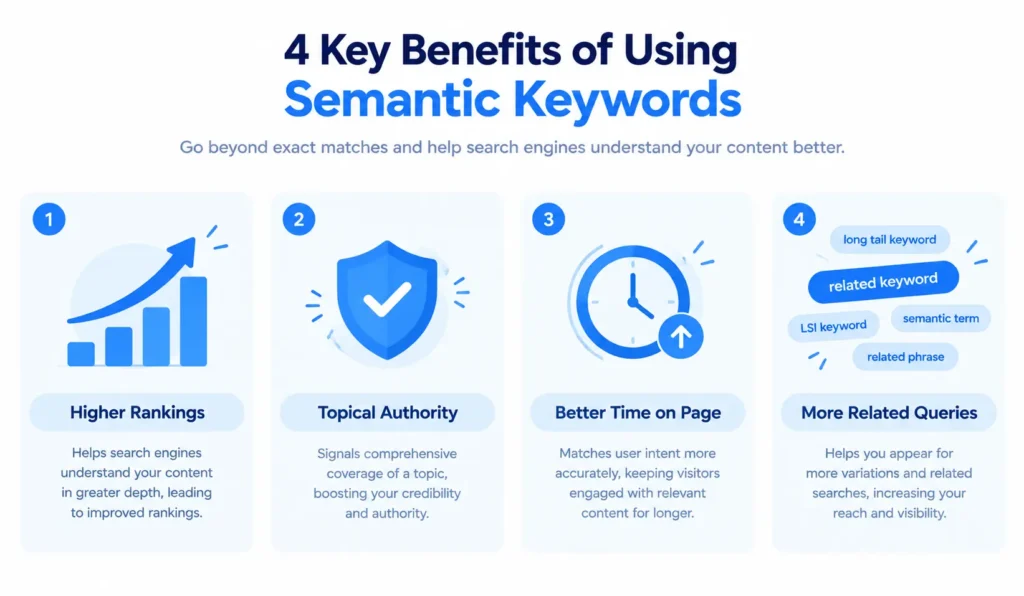
1. Higher Search Engine Rankings
Content that covers a topic comprehensively through related semantic terms tends to rank for more keyword variations than content that only repeats the exact target phrase.
Google’s Hummingbird and RankBrain updates in the 2010s shifted the algorithm’s evaluation from keyword matching to topic understanding.
Semantic coverage became a ranking signal as a direct result of these updates, and that shift has only deepened with subsequent NLP improvements.
2. Increased Content Credibility and Topical Authority
Pages that use the full vocabulary of a topic naturally demonstrate expertise. They read like they were written by someone who genuinely understands the subject, not someone who optimized a page for a single phrase.
Google’s E-E-A-T guidelines explicitly reward demonstrated expertise in content, and semantic depth is one of the practical signals that supports the Expertise and Authoritativeness dimensions of that evaluation.
3. Improved Time on Page and Lower Bounce Rates
Content that comprehensively covers a topic keeps readers on the page longer because they find the answers to follow-up questions without needing to leave and perform another search.
Reduced bounce rates and increased dwell time are engagement signals that Google uses as secondary ranking factors, creating a compounding benefit from strong semantic coverage.
4. Ranking for More Related Queries
One well-written article that uses semantic keywords naturally can rank for dozens of related search variations without targeting each one individually.
This is the multiplier effect of semantic SEO. A single piece of content built around thorough semantic coverage generates an organic ranking footprint that narrow, focused exact-keyword content cannot match.
How to Find LSI Keywords (Free Methods)
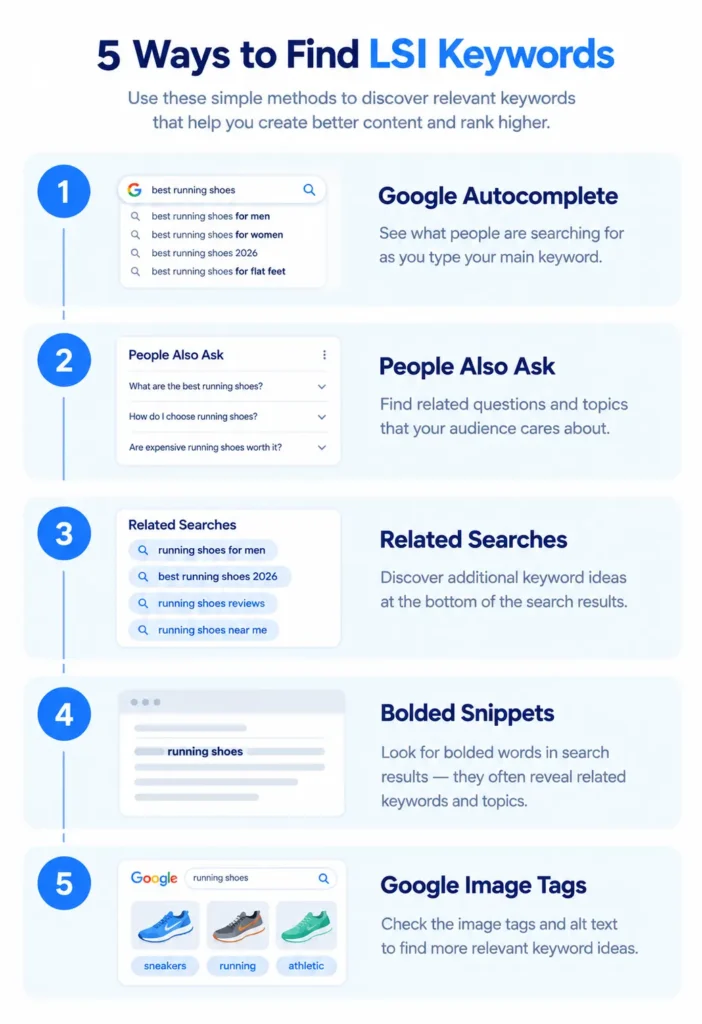
These five methods cost nothing and produce LSI keyword results directly from Google’s own understanding of your topic no tool subscription required.
1. Google Autocomplete
Type your main keyword into the Google search bar and pause before pressing Enter.
The dropdown suggestions that appear are real related searches from actual users, filtered and organized by Google’s understanding of what topics associate with your query.
These are among the most valuable LSI keyword signals available because they come directly from the source.
To surface additional variations, try adding a letter or number after your keyword. Searching “finding lsi keywords a,” “finding lsi keywords b,” and so on reveals additional autocomplete suggestions that do not appear in the default dropdown. Work through the alphabet to build a comprehensive list of semantic variations.
2. People Also Ask (PAA)
Search your main keyword and look at the “People Also Ask” box that appears in the results. Each question represents a semantically related query that Google has determined is strongly associated with your search term.
These questions are direct signals of what topics your content should cover to be considered comprehensive.
Clicking to expand an answer within the PAA box generates additional questions, creating an expandable tree of related semantic content ideas.
A single starting keyword can generate dozens of LSI keyword candidates through this method alone.
3. Google Related Searches
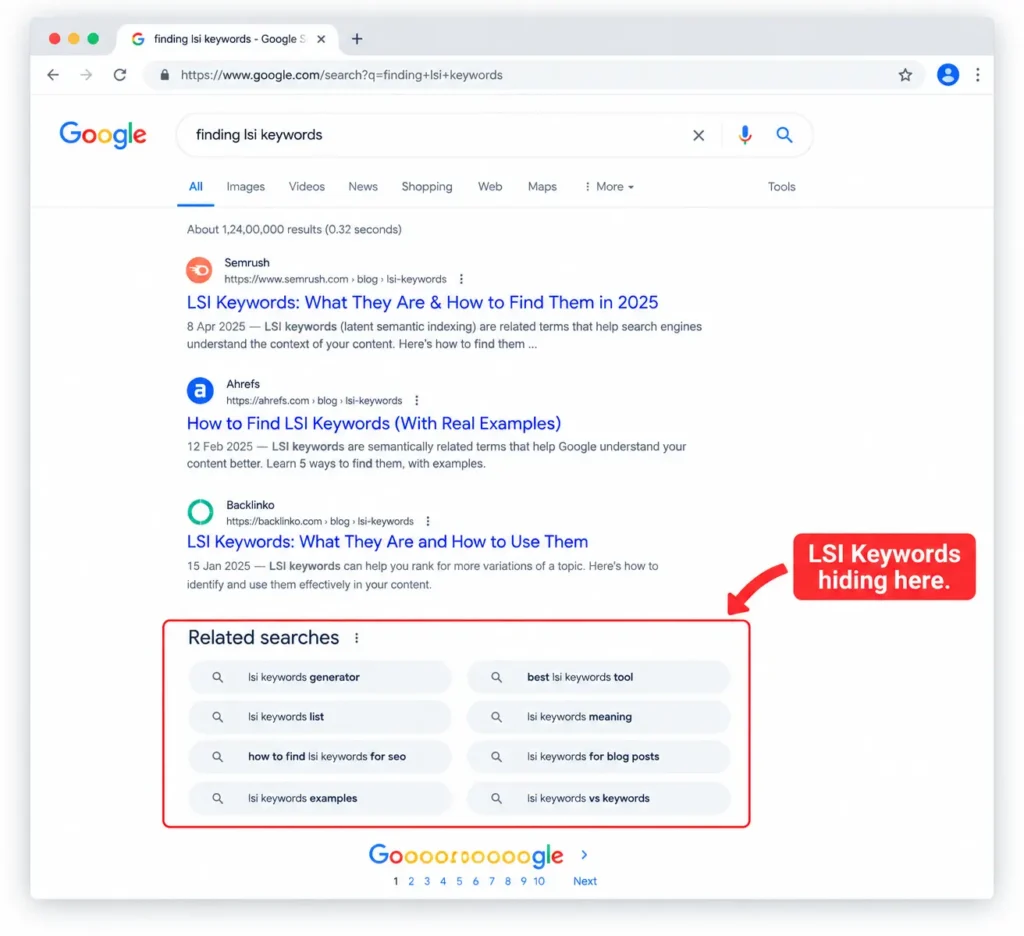
Scroll to the very bottom of any Google search results page. The “Related Searches” section displays eight additional queries Google associates with your search.
These are strong LSI keyword candidates because they represent Google’s own semantic grouping of your topic. This section frequently surfaces longer-tail variations you would not have found through autocomplete.
4. Bolded Words in Search Snippets
Run your target keyword search and read the meta description snippets displayed for the top results. Any word Google has bolded in those snippets, beyond your exact keyword, is a term Google considers semantically associated with your query.
These are high-confidence LSI keyword signals that most SEOs overlook because they focus on the rankings rather than the snippet text.
5. Google Image Tags
Search your keyword in Google Images and look at the colored keyword filter tabs that appear at the top of the image results.
These tags are Google’s own semantic categorization of your topic, representing the related concepts it considers directly associated with your keyword. Every tag is a potential LSI keyword for your content.
Best LSI Keyword Generator Tools (Free and Paid)
Free LSI Keyword Generator Tools
| Tool | What It Does | Best For | Limitation |
|---|---|---|---|
| LSI Graph | Enter any keyword and instantly generate a list of semantically related terms | Bloggers and content writers who want a fast free starting point | No search volume data — needs a second tool to validate demand |
| Answer Socrates | Generates question-based LSI keywords grouped by who, what, when, where, why, and how | Building FAQ sections, PAA-optimized content, and question-based H2 headings | Limited to question-format suggestions only |
| Google Keyword Planner | Free keyword ideas with actual monthly search volume data attached | Validating which LSI keywords have real search demand before using them | Requires a free Google Ads account to access |
| Google Autocomplete | Type your keyword into Google search and mine the dropdown suggestions | Quick semantic keyword ideas pulled directly from real user searches | Manual process with no bulk export option |
| Google Related Searches | Eight semantically grouped queries at the bottom of every SERP | Finding longer-tail LSI variations you would not find through autocomplete | Limited to eight results per search |
Paid SEO Tools With LSI Keyword Features
| Tool | What It Does | Best For | Starting Price |
|---|---|---|---|
| Semrush Keyword Magic Tool | Surfaces semantically associated terms via the Related filter plus competitor gap analysis | Content teams who want LSI keywords alongside volume, difficulty, and competitor data | $117.33/mo (annual) |
| Ahrefs Keywords Explorer | “Also rank for” and “Related terms” reports show LSI keywords based on actual ranking data | Finding high-value semantic terms proven to rank for your exact topic | $129/mo |
| Surfer SEO Content Editor | Analyzes top-ranking pages and shows which semantic terms your draft is missing in real time | Writers who want LSI keyword guidance built into the drafting process | $79/mo |
| Serpstat | Related keywords report with volume and competition data alongside semantic grouping | Mid-range option between a free tool and a full SEO platform | $59/mo |
Also read: Ahrefs vs SEMrush 2026 – Which SEO Tool Should You Use?
How to Find LSI Keywords Through Competitor Analysis
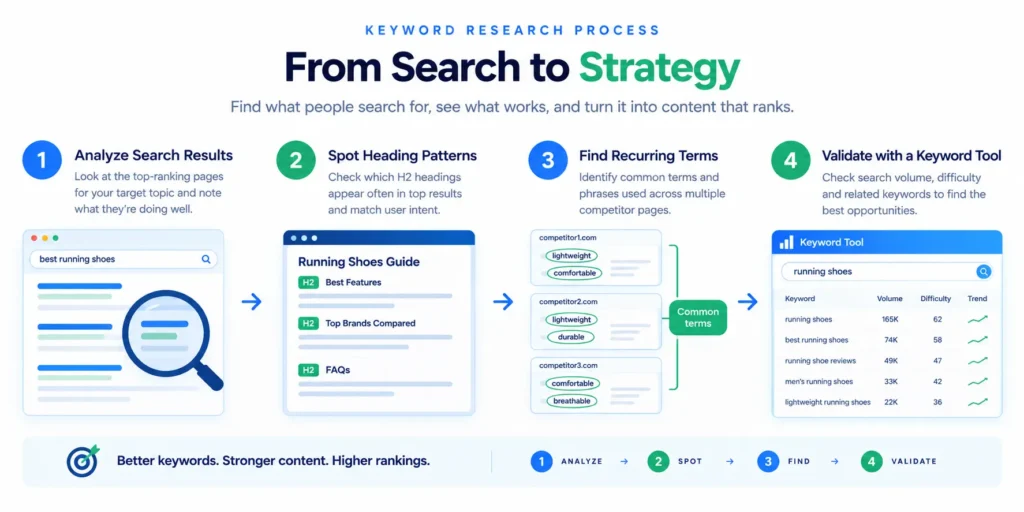
Competitor pages that already rank for your target keyword have essentially done your LSI keyword research for you.
Here is how to extract that research in four steps.
- Step 1: Open the top three to five pages ranking for your target keyword. These pages have passed Google’s relevance threshold. The topics they chose to cover and the vocabulary they used to cover them represent the semantic landscape Google has already validated for your keyword.
- Step 2: Scan their H2 and H3 subheadings. The section topics your competitors chose are the most visible signal of semantic coverage. If every top-ranking page has a section about a specific related concept, that concept belongs in your content too.
- Step 3: Look for recurring terminology across multiple ranking pages. If three of the top five results all mention the same specific related term in their body copy, that term is almost certainly a high-value LSI keyword. One page mentioning a term could be coincidence. Three pages mentioning it is a pattern Google has rewarded.
- Step 4: Use Keywords Everywhere or Ahrefs to find which other keywords those pages rank for. The semantic terms producing their multi-keyword ranking footprint are your most valuable LSI keyword opportunities. These are not just related terms. They are related terms with proven ranking value for your exact topic. For a full breakdown of free keyword research browser tools, see our Keywords Everywhere Alternative guide.
LSI Keywords vs Semantic Keywords: What Is the Difference?
| LSI Keywords | Semantic Keywords | |
|---|---|---|
| Technical definition | Based on Latent Semantic Indexing, a specific mathematical technique from the 1980s | Broader term covering all words that share meaning or context with your topic |
| Does Google use it? | Not technically. The term is a misnomer in modern SEO | Yes. Google’s NLP models and vector embedding systems are fundamentally semantic |
| Practical SEO value | High. Even if misnamed, the practice produces real ranking improvements | High. Semantic keyword research is the correct modern terminology |
| Tools named after it | LSI Graph, LSI keyword generators | Surfer SEO, Semrush Related Terms, Ahrefs “Also Rank For” reports |
The bottom line is straightforward. LSI keyword is the older, technically inaccurate but widely used term. Semantic keyword is the correct modern terminology.
Both refer to the same practical SEO activity: finding and using related terms that comprehensively cover your topic. If you encounter both terms in your research, they are describing the same work.
FAQs About Finding LSI Keywords
What are LSI keywords?
LSI keywords are words and phrases semantically related to your main topic that commonly appear alongside it across the web. They help search engines understand the full context of your content beyond the exact keyword phrase you are targeting.
Are LSI keywords the same as synonyms?
No. Synonyms replace your keyword with a word that means the same thing. LSI keywords expand the semantic field around your topic with related concepts that frequently appear alongside it. “Car” and “automobile” are synonyms. “Engine,” “fuel efficiency,” and “dealership” are LSI keywords for the topic of cars.
Does Google use LSI keywords?
Not technically. Google has confirmed it does not use Latent Semantic Indexing as a specific algorithm component. What Google uses instead are vector embeddings, the Knowledge Graph, and NLP models including BERT, RankBrain, and MUM. However, the practical effect of using semantically related terms still improves rankings because these modern systems still reward comprehensive topical coverage.
How do I find LSI keywords for free?
The five most reliable free methods are Google Autocomplete, People Also Ask, Google Related Searches, bolded words in search snippets, and Google Image Tags. For dedicated free tools, LSI Graph and Answer Socrates both generate semantic keyword lists without a paid subscription.
What is the best LSI keyword generator tool?
For free use, LSI Graph is the most widely used starting point. For paid tools, Surfer SEO is the most integrated option for finding LSI keywords during the content writing process. Semrush and Ahrefs are the most comprehensive for building full semantic keyword research lists alongside search volume and competition data.
What is the difference between LSI keywords and semantic keywords?
LSI keyword is the older term based on a specific 1980s mathematical technique. Semantic keyword is the correct modern terminology. Both describe the same practical SEO activity: finding and using related terms that comprehensively cover your topic in a way that helps search engines understand your content fully.
How many LSI keywords should I use per article?
There is no fixed number. The goal is natural topical coverage, not hitting a specific count. A 2,000-word article on a focused topic might naturally include 10 to 20 related semantic terms. A comprehensive 4,000-word guide might include 40 or more. Write for the human reader, and the semantic coverage follows naturally from thorough writing.
Where should I place LSI keywords in my content?
Place them naturally in H2 and H3 subheadings where they fit the section topic, in the introduction and conclusion, in the body paragraphs where the related concept is being discussed, and in image alt text where the image relates to the term. Never force a semantic keyword into a sentence where it does not read naturally. Google’s NLP models detect unnatural language patterns.
Does YouTube use LSI keywords?
Yes. YouTube’s algorithm uses semantic analysis similar in principle to Google’s web search. Using related semantic terms in titles, descriptions, tags, and chapter headings improves a video’s ability to surface for related search queries beyond its exact target keyword.
Are LSI keywords still relevant in 2026?
Yes, with an honest caveat. The term “LSI keywords” is technically outdated since Google does not use classical Latent Semantic Indexing. But the underlying practice, using semantically related terms to provide comprehensive topical coverage, is more relevant in 2026 than ever. Google’s increasingly sophisticated NLP models reward content that demonstrates genuine topic understanding, and using related semantic terms naturally is the clearest signal of that understanding.
Final Thought
Finding LSI keywords and using them naturally is one of the most practical and cost-effective ways to expand your article’s ranking footprint.
The free methods covered in this guide, from Google Autocomplete to competitor analysis, cost nothing to use and can produce a comprehensive semantic keyword list in under 30 minutes.
The payoff is ranking for dozens of related queries from a single well-written article rather than targeting each variation individually with separate content.
For more on how topical coverage connects to your overall on-page optimization, see our On-Page SEO Checklist. For the off-page signals that amplify the topical authority your semantic content builds, see our Off-Page SEO Tactics guide.
ALSO READ: